 Catholica

Ever since I converted to Catholicism from Protestantism I’ve had people ask, “What’s the difference between Roman Catholics and Christians?”
Overlooking the question’s weird phrasing (after all, Catholics are Christians), I’ve always been happy to answer.
In short, there are many types of Christians:
- Catholics
- Orthodox (e.g. Russian, Coptic, etc.)
- Protestants (e.g. Baptists, Evangelicals, Episcopalians, etc.)
When most people ask about the difference between Christians and Catholics, they’re really asking about the difference between Catholics and Protestants.
And since Protestantism itself is so varied, I’ll be focusing on Evangelicals and Baptists, the largest Protestant tradition in the US and the ones most readers usually mean.[1]
Evangelicals and Baptists share most of the core teachings of Christianity with Catholics (the Trinity, the divinity of Christ, His resurrection), but here are 12 key differences in beliefs…
Differences Between Catholics and Protestants #
- Scripture
- Tradition
- Sin
- Salvation and Justification
- The Cross
- The Afterlife
- Relationship with Jesus
- The Eucharist
- Priesthood
- Peter
- Mother Mary
- Saints
1. Scripture #
Catholics and Protestants differ in their approach to the Word of God.
- Catholic Bibles have 73 books compared to Protestantism’s 66 books.
- Protestants view Scripture through the lens of “Sola Scriptura” (“by Scripture alone” in English), whereas Catholics don’t.
These two differences largely trace back to the 16th-century Protestant reformer, Martin Luther, though doubts about the extra books were much older than him, since even St. Jerome had questioned them.[2]
In his 1534 Bible, Luther moved Tobit, Judith, 1 & 2 Maccabees, the Wisdom of Solomon, Ecclesiasticus, Baruch, the Letter of Jeremiah and additions to Esther and Daniel out of the Old Testament proper and into an appendix titled “Apocrypha: Books which are not held equal to Holy Scripture, but are useful and good to read”.[3]
But he didn’t remove them from the Bible entirely. Protestant Bibles kept printing the Apocrypha for nearly three more centuries, until the British and Foreign Bible Society stopped funding it in the 1820s.[4]
He also considered Hebrews, James, Jude and Revelation “disputed books” and doubted their divine inspiration.[5]
He also popularized a new way of viewing the Bible: Luther saw the Bible alone as containing the totality of God’s revelation to mankind and as the sole authority to guide the Church and a Christian’s life.[6]
Luther’s personal interpretations of the Bible led him to reject many Traditions of the Catholic Church that he felt were not supported by those books of the Bible he recognised.
After his death, this view of Luther evolved to mean that all Christians can interpret and understand Scripture individually without the help of an authoritative Church.[7]
Meanwhile, the Catholic Church retained its 73-book canon (formally defined at the Council of Trent in 1546, partly in response to the Reformation) and rejected the notion of Sola Scriptura.[8]
2. Tradition #
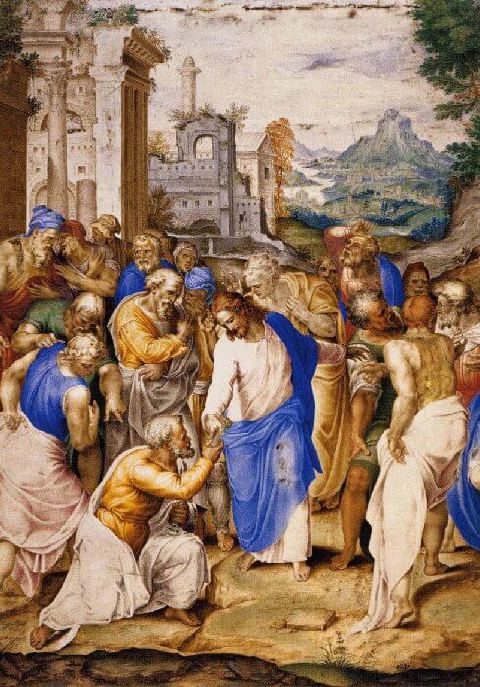
“Christ Giving the Keys to St. Peter” painted by Bernardo Castello in 1598AD.
The Catholic Church believes its origin can be found in the words of Jesus to Peter in Matthew 16:18, “you are Peter, and on this rock I will build my church.”
It also believes that Jesus promised, through His Holy Spirit, to guide His Church into “all truth”[9] and make it the “pillar of truth”.[10]
Catholics see this truth as having been communicated orally as well as written down.[11]
Hence, oral Traditions that have their source in Jesus and are definitively taught by this Holy Spirit-guided Church are held with the same reverence as the Bible.[12]
This same Sacred Tradition, protected by the Holy Spirit, is also believed to have helped codify the Bible and help know which books should be included in it.[13]
Merely historical or cultural traditions that don’t have their source in Jesus are not considered as authoritative as the Bible. (This distinction is often shown through the capitalization “tradition” vs. “Tradition”.)[14]
Protestants, while recognising the usefulness of some historical or cultural traditions (lowercase), do not believe in Sacred Tradition (uppercase) and so tend to see the Bible as a standalone authority that exists almost in a vacuum.
3. Sin #
Both Catholics and Protestants believe mankind is born into a fallen state, though they describe its effects differently.
Some Protestants, especially those in the Reformed tradition, see original sin as the “total depravity” of man, whose fallen descendants are “dead in sin, and wholly defiled in all the faculties and parts of soul and body”.[15] Baptists put it more mildly: the Southern Baptist Convention’s statement of faith says Adam’s descendants “inherit a nature and an environment inclined toward sin”.[16] That’s actually closer to the Catholic description: human nature “has not been totally corrupted”, but is “wounded” and “inclined to evil”.[17]
Where the real difference lies is in how sin is categorised. Evangelicals and Baptists do not split sin into formal categories, whereas Catholics distinguish between sins that “lead to death” and sins that don’t: mortal and venial sins respectively.[18] Even some Protestants half-share that distinction, since the Westminster Larger Catechism admits some sins “are more heinous in the sight of God than others”.[19]
The practical difference is that Catholics believe mortal sins deprive the soul of grace and must ordinarily be confessed to a priest to be forgiven. Though not always: perfect contrition (sorrow for sin out of love for God) also obtains forgiveness, provided it includes the resolve to go to confession afterwards.[20] (More on that difference here.)
4. Salvation and Justification #
Protestants typically see salvation as a past, one-time event when they accepted Jesus as their Lord and Saviour.
Baptists and Evangelicals are also often taught that “all true believers endure to the end”, that a person saved by faith can never fall away from grace.[21]
Catholics see salvation as a past, present and future event that they can potentially squander and must “work out” until death.[22]
They believe a person is “justified by works and not by faith alone”.[23] Not in the sense that they must do good works in order to be forgiven, but that they’re saved by an active faith that is formed by love and which is not an unconditional “golden ticket” to heaven.
Other Protestants, Arminians such as Methodists, Wesleyans and most Pentecostals, agree salvation can be forfeited.
Still, this old battle has cooled a lot on paper. In 1999 the Catholic Church and the Lutheran World Federation jointly declared that “a consensus in basic truths of the doctrine of justification exists between Lutherans and Catholics”, and Methodist, Anglican and Reformed world bodies have since affirmed it.[24]
5. The Cross #
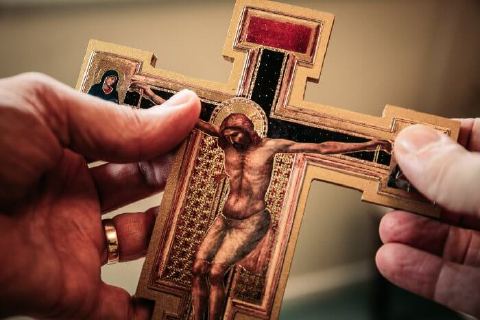
Protestants typically interpret the cross in terms of punishment and substitution: Christ bearing in man’s place the penalty his sin deserved: “upon him was the punishment that made us whole”.[25]
The Catholic Church has never dogmatically defined one theory of the Cross, but since St. Anselm’s writings in the 11th-century, Catholic theologians have usually described it similarly while preferring “satisfaction” and “obedience” to “punishment”.[26]
In this view, the cross was Jesus’ restitution or “satisfaction” for mankind’s sin by His perfect obedience to the Father’s will.[27]
This type of language is also expressed in Philippians 2:8: “He humbled himself and became obedient to the point of death—even death on a cross.”
6. The Afterlife #
Catholics and Protestants believe in heaven and hell as two possible places people go after death.
Catholics also believe in an intermediary state called Purgatory where righteous people go temporarily to be fully purified and to finish making reparation for the temporal punishment due to sins.[28]
7. Relationship with Jesus #
Protestants such as Baptists and Evangelicals emphasise a personal relationship with Jesus that is communicated entirely heart-to-heart.
They also sometimes see the external rules and rituals of Catholicism as stifling that heart-to-heart relationship.
Catholics also believe in a heart-to-heart, personal relationship with Jesus (“not the result of an ethical choice or a lofty idea, but the encounter with an event, a person”, as Pope Benedict XVI put it[30]), though one that blossoms and is kept safe by the help of Christ’s Church and sacraments.[31]
8. The Eucharist #
Catholics believe the bread and wine, under the action of the priest, substantially become Jesus’ body and blood.[32]
For this reason, Catholics consider the Eucharist the centre of the Christian life and offering it the highest form of worship to God.[33]
Most Protestants such as Evangelicals and Baptists believe that the bread and wine in Holy Communion are only symbolic of Jesus’ body and blood.
Because of this symbolic view, their worship services usually centre on preaching the Bible and congregational praise, and they see the Eucharist (i.e. “the Lord’s Supper”) simply as a way to remember Jesus’ sacrifice.
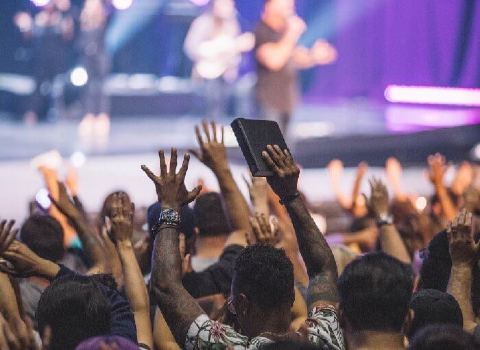
This is usually what an Evangelical or Baptist will think of as a worship service, but worship is construed differently by Catholics.
9. Priesthood #
Baptists and Evangelicals don’t believe in a specific New Testament priesthood but think that all believers are priests in a general sense. And they have Scripture on their side: Christians are called “a royal priesthood” in 1 Peter 2:9.[34]
Catholics wholeheartedly agree with this general sense,[35] but they also believe in a specific priesthood that started with the Twelve Apostles and was passed down through the centuries[36]: the doctrine of Apostolic succession, which Baptists and Evangelicals reject.
10. Peter #
Catholics believe Peter was the chief Apostle who was given special authority by Jesus.[37]
Early Christian writers record that, at the time of his death in Rome, Peter was succeeded by a man called Linus, and that each bishop of Rome has since passed that authority on to a successor.[38]
And so for Catholics, the current Pope is a direct successor to Peter and shares his authority.
While Protestants such as Baptists and Evangelicals more-or-less agree that Peter was the chief Apostle, they don’t typically believe in Apostolic succession.
Hence, they do not believe Peter has a living successor.
11. Mother Mary #
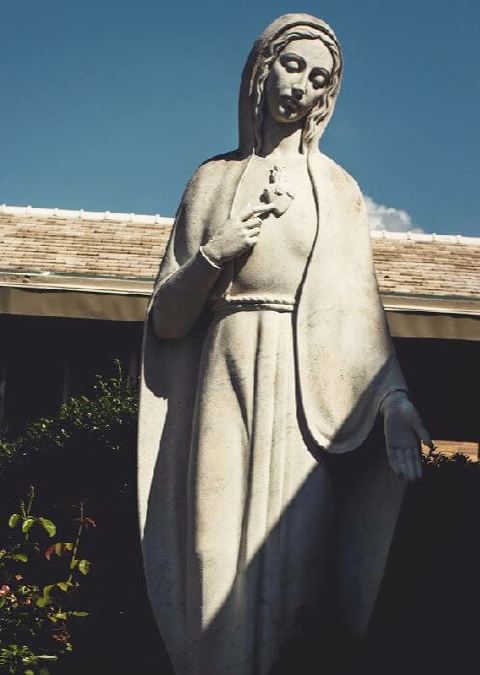
Most modern Protestants (especially Baptists and Evangelicals) see Mary simply as a devout woman chosen to be the mother of Jesus.
But it wasn’t always so among Protestants: Martin Luther affirmed her perpetual virginity all his life, and most of the early Reformers embraced the ancient Church’s teaching on her.[39] Catholics still hold that older view: they believe that Scripture and Tradition teach she was a perpetual virgin, immaculately conceived, assumed into heaven, and coronated the Queen of Heaven too.[40]
Two of those beliefs were only formally defined in modern times (the Immaculate Conception in 1854 and the Assumption in 1950), though the Church holds both were always part of the faith.[41]
12. Saints #
Some Protestants such as Evangelicals like to call all baptised Christians “saints”.
Catholics recognise the validity and biblical-origin of this language though aren’t prone to use it since it has become a title in the Catholic Church.
“Saint” (with the uppercase “S”), is a title normally only ascribed to canonized saints that the Church have investigated and found worthy of imitation.
Moreover, Protestants don’t usually ask deceased saints to pray for them as Catholics do, with some even considering it idolatrous.
But Catholics see the Church on Earth and the Church in Heaven as one communion, “a great cloud of witnesses”, and so ask saints to pray for them in the same way they may ask a friend on Earth to pray for them.[42]
Please note that this was a basic introduction to these real (and sometimes contentious) differences between Catholic Christians and Protestant Christians.
Footnotes: #
1. Pew Research Center’s 2015 demographic study, America’s Changing Religious Landscape: the Evangelical tradition (which includes Baptist denominations) is the largest Christian tradition in the US at 25.4% of adults, ahead of Catholics (20.8%) and Mainline Protestants (14.7%). ↑
2. St. Jerome repeatedly expressed doubt that the “second canon” books belonged to Scripture, following the Jewish canon he learnt while translating the Hebrew Bible, though he still translated them into Latin for the Church’s use. See his “Preface to the Books of Samuel and Kings” (the “helmed preface”), which relegates them to the apocrypha. ↑
3. The 1534 Luther Bible’s Apocrypha title page reads: “Apocrypha. These books are not held to be equal to Holy Scripture, but they are useful and good to read.” — The Gruber Collection, Lutheran School of Theology at Chicago. ↑
4. Even the 1611 King James Bible contained the Apocrypha. The British and Foreign Bible Society, after funding Apocrypha-containing Bibles on the continent until 1822, resolved in 1826–27 never to fund editions containing it, and it largely vanished from Protestant Bibles afterwards. See the Society’s 1825 “Statement of the Bible Society concerning the Apocrypha” and William Canton’s “A History of the British and Foreign Bible Society”, chapter XXIX. ↑
5. “Up to this point we have had to do with the true and certain chief books of the New Testament. The four which follow [i.e. Hebrews, James, Jude and Revelation] have from ancient times had a different reputation.” — Martin Luther’s preface to Hebrews. ↑
6. “A simple layman armed with Scripture is to be believed above a pope or a council without it…neither the Church nor the pope can establish articles of faith. These must come from Scripture.” — Roland H. Bainton’s book “Here I Stand”, page 117. ↑
7. “…most Protestants have adopted a subjective and individualistic version of sola scriptura that bears little resemblance to the doctrine of the Reformers.” — Keith A. Mathisons’s introduction to “The Shape of Sola Scriptura”, pages 13-14. ↑
8. “Decree Concerning the Canonical Scriptures” from the 4th session of the Council of Trent. ↑
9. John 16:13 ↑
10. 1 Timothy 3:15 ↑
11. 2 Thessalonians 2:15 and the “Decree Concerning the Canonical Scriptures” from the 4th session of the Council of Trent: “…seeing clearly that this truth and discipline are contained in the written books, and the unwritten traditions.” ↑
12. “Sacred Tradition and Sacred Scripture are to be accepted and venerated with the same sense of loyalty and reverence.” — Dei verbum, chapter 2, point 9. ↑
13. “It is clear, therefore, that sacred tradition, Sacred Scripture and the teaching authority of the Church, in accord with God’s most wise design, are so linked and joined together that one cannot stand without the others.” — Dei verbum, chapter 2, point 10. ↑
14. “The Tradition here in question comes from the apostles and hands on what they received from Jesus’ teaching and example and what they learned from the Holy Spirit… This is different from the various theological, disciplinary, liturgical, or devotional traditions, born in the local churches over time.” — Catechism of the Catholic Church, paragraph 83. ↑
15. “By this sin they fell from their original righteousness and communion with God, and so became dead in sin, and wholly defiled in all the faculties and parts of soul and body.” — The Westminster Confession of Faith, chapter 6, section 2. ↑
16. “…his posterity inherit a nature and an environment inclined toward sin. Therefore, as soon as they are capable of moral action, they become transgressors and are under condemnation.” — The Baptist Faith and Message, article 3 (“Man”), adopted by the Southern Baptist Convention in 2000. ↑
17. “…human nature has not been totally corrupted: it is wounded in the natural powers proper to it, subject to ignorance, suffering and the dominion of death, and inclined to sin — an inclination to evil that is called ‘concupiscence’.” — Catechism of the Catholic Church, paragraph 405. ↑
18. 1 John 5:16 ↑
19. “All transgressions of the law of God are not equally heinous; but some sins in themselves, and by reason of several aggravations, are more heinous in the sight of God than others.” — Westminster Larger Catechism, question 150. ↑
20. “Such contrition remits venial sins; it also obtains forgiveness of mortal sins if it includes the firm resolution to have recourse to sacramental confession as soon as possible.” — Catechism of the Catholic Church, paragraph 1452. ↑
21. “All true believers endure to the end. Those whom God has accepted in Christ, and sanctified by His Spirit, will never fall away from the state of grace, but shall persevere to the end.” — The Baptist Faith and Message, article 5 (“God’s Purpose of Grace”). ↑
22. Philippians 2:12 ↑
23. James 2:24 ↑
24. “Joint Declaration on the Doctrine of Justification” (1999), points 5 and 40-41. It was affirmed by the World Methodist Council in 2006 and later associated with by the Anglican Consultative Council and the World Communion of Reformed Churches. ↑
25. Isaiah 53:5 ↑
26. “Jesus atoned for our faults and made satisfaction for our sins to the Father.” — Catechism of the Catholic Church, paragraph 615. ↑
27. “Anselm did not teach penal substitution. Yes, he brought to prominence the vocabulary of ‘satisfaction’, which became important in later formulations. But in Anselm’s feudal thought-world, it was God’s honour that needed to be satisfied by substitutionary obedience, not his justice by substitutionary penalty.” — Response to N.T. Wright’s criticism of “Pierced for Our Transgressions” from the authors. ↑
28. 2 Maccabees 12:39-46, Matthew 5:25-26, 1 Corinthians 3:11-15. ↑
29. “The forgiveness of sin and restoration of communion with God entail the remission of the eternal punishment of sin, but temporal punishment of sin remains… These two punishments must not be conceived of as a kind of vengeance inflicted by God from without, but as following from the very nature of sin.” — Catechism of the Catholic Church, paragraphs 1472-1473. ↑
30. “Being Christian is not the result of an ethical choice or a lofty idea, but the encounter with an event, a person, which gives life a new horizon and a decisive direction.” — Pope Benedict XVI’s “Deus Caritas Est”, paragraph 1. ↑
31. “The seven sacraments touch all the stages and all the important moments of Christian life: they give birth and increase, healing and mission to the Christian’s life of faith.” — Catechism of the Catholic Church, paragraph 1210. ↑
32. John 6:32–71, 1 Corinthians 10:16–17, 11:23–29, St. Ignatius of Antioch’s “Letter to the Romans” (7:3), “Letter to the Smyrnaeans” (chapter 7). ↑
33. Catechism of the Catholic Church, paragraph 1324. ↑
34. 1 Peter 2:5, 1 Peter 2:9 ↑
35. “Christ the Lord, High Priest taken from among men, made the new people ‘a kingdom and priests to God the Father’.” — Lumen gentium, chapter 2, paragraph 10. ↑
36. Lumen gentium (chapter 2). ↑
37. Matthew 16:18-19, John 21:15-17, and more found here. ↑
38. Eusebius of Caesarea’s “Church History” (3:4:9–10, 5:28:3), St. Ireneaus of Lyon’s “Against Heresies” (3:3:3), St. Epiphanius of Salamis’s “Medicine Chest Against All Heresies” (Section II), etc. ↑
39. For many of the Protestant reformers (e.g. Luther, Zwingli, and Calvin), their theological commitments included Mary’s perpetual virginity and even the assumption of her sinlessness. — “Virginity in the Christian Tradition” (citing Beth Kreitzer, 2004), page 9. Luther repeatedly affirmed that Mary remained a virgin after Christ’s birth. ↑
40. See here for biblical support. ↑
41. Pope Pius IX’s “Ineffabilis Deus” (1854) defined the Immaculate Conception; Pope Pius XII’s “Munificentissimus Deus” (1950) defined the Assumption. ↑
42. Revelation 5:8, Revelation 8:3-4, Hebrews 12:1, Matthew 17:3, Mark 12:27, and see here for more. ↑