 Catholica

Devotion to Our Lady of Sorrows and the Seven Sorrows of Mary #
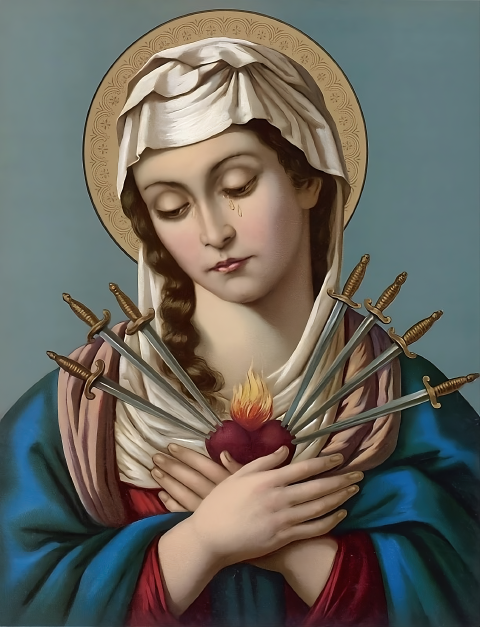
“I look around at everyone who is in the world to see if there happens to be some who might have compassion on me and be mindful of my sorrow, but I find very few who think about my sorrow and tribulation. This is why, my daughter, although I am forgotten and neglected by many people, you must not forget me! Look at my struggles and imitate them as far as you can! Contemplate my sorrow and tears and be sorry that the friends of God are so few. Stand firm! Look, my Son is coming.”
Our Lady of Sorrows to St. Bridget of Sweden1
Our Lady of Sorrows is a title that has been used for Mary since medieval times. She used the title herself during her Fatima apparitions!
This beautiful devotion focuses on Mary’s suffering, inviting us to put ourselves in her place and experience her pain, as she witnesses her beloved son, Jesus, be rejected, tortured, and killed.
Our Lady of Sorrows never left her Son’s side; she was there during His childhood, His ministry, and His death. The Church encourages us to prayerfully meditate on this, highlighting seven moments from Her life, called the Seven Sorrows of Mary.
Will you have compassion on her?
Will you remember her pain?
Will you stand with her, next to her Son, Jesus?
Those who do are promised many blessings!
The Seven Sorrows of Our Lady #
1. The Prophecy of Simeon—Luke 2:34-35 #
When Jesus was just 40 days old, Mary took Him to the temple, as was the Jewish custom. Whilst there, a “righteous and devout” man called Simeon, prophesied that her Son was destined to be “a sign that will be spoken against” and also that a “sword would pierce” Mary’s soul.
Our Lady of Sorrows revealed to St. Mechthild of Hackeborn that from this moment, her joy turned to sorrow2 as she learnt how much her Son would suffer.
2. The Flight to Egypt—Matthew 2:13-14 #
King Herod, hearing about the birth of a coming Messiah, ordered the death of every child in Bethlehem under the age of 2. Joseph was warned in a dream, so they fled with Jesus to Egypt. Her Son had just been born, and, confirming Simeon’s prophecy, he was already condemned to death! 3
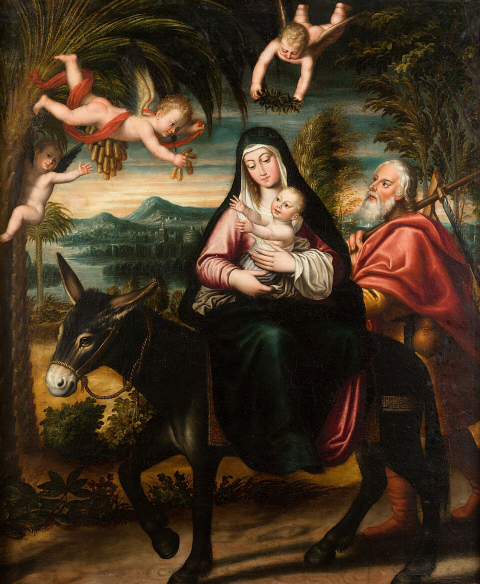
The route was difficult4 and they lived in Egypt, according to St. Basil of Seleucia (5th century), in complete poverty.5
3. The Loss of the Child Jesus in the Temple of Jerusalem—Luke 2:41-52 #
Every year, Mary and Joseph took Jesus to Jerusalem for the Passover. When Jesus was 12, he stayed in Jerusalem without Mary realising—she thought He was travelling back with another family member.
She desperately searched for Him for 3 days, eventually finding Him in the temple. After revealing to Jesus how much pain this had caused her, He replied: “Didn’t you know I had to be in my Father’s house?”
4. Mary meeting Jesus on the Via Dolorosa—Meditationes vitae Christi, early 14th century 6 #
When Jesus was sentenced to death, he carried the cross along a road called Via Dolorosa. According to tradition, Mary met him along the way.
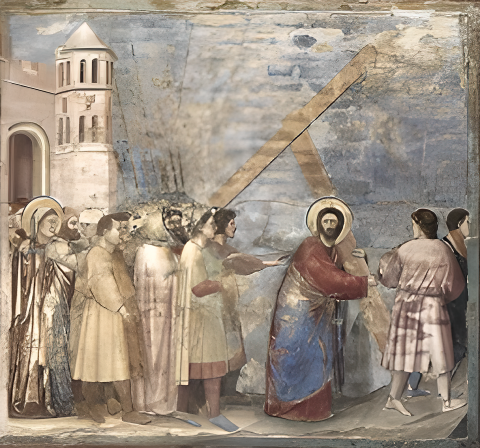
Imagine Our Lady of Sorrows, waiting on a street corner. She hears the mocking crowd, she sees the procession of soldiers carrying the nails, hammers, and cords. Suddenly, a man comes into view, covered in blood, a wreath of thorns on his head and two beams on his shoulders.3
Through the bruises and the blood, she eventually recognises her Son.
5. The Crucifixion of Jesus on Mount Calvary—John 19:16-27 #
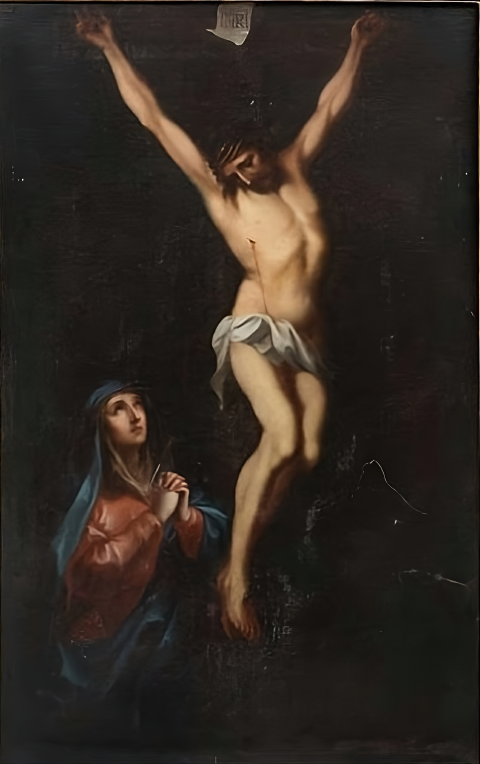
“My dear Jesus was on the cross in grief and in agony; his eyes were sunken, half closed, and lifeless; the lips hanging, and the mouth open; the cheeks hollow, and attached to the teeth; the face lengthened, the nose sharp, the countenance sad; the head had fallen upon his breast, the hair black with blood, the stomach collapsed, the arms and legs stiff, and the whole body covered with wounds and blood.”
Our Lady of Sorrows to St. Bridget of Sweden1
Imagine Mary’s sorrow as she stands at the foot of the cross, watching her precious child die! Amazingly, Jesus tries to comfort her by entrusting her to John’s care.
St. Cyril of Alexandria (5th century) believes, at this lowest moment, Mary suffered from doubt.7 Even though God kept her from sin, she was still human!
6. Jesus’ Descent from the Cross—Matthew 27, Mark 15, Luke 23, and John 19 #
Our Lady of Sorrows then witnesses Jesus’ side pierced with a spear, and blood and water pours out. Jesus now has no more blood left to give.3 Although not physically, the spear pierced Mary’s heart too. St. Bernard of Clairvaux said this was the fulfilment of Simeon’s prophesy.8
Three ladders were then placed next to the cross, and His disciples took the nails from His hands and feet.1 His body was carefully carried down and the nails were given to Mary.9
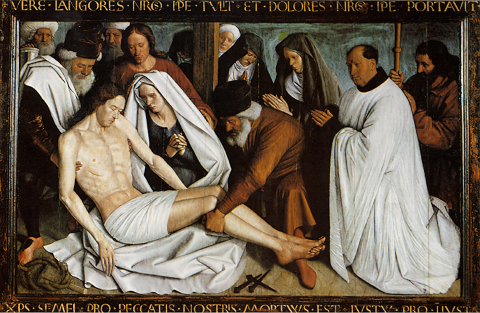
Cradling her Son, she gently closes his eyes.1
7. The Burial of Jesus by Joseph of Arimathea—Matthew 27, Mark 15, Luke 23, and John 19 #
Some disciples gently take Jesus’ body from Mary’s arms and embalm him. With Mary following, they carry Him on their shoulders1 to a freshly cut tomb owned by Joseph of Arimathea and lay him in there. Our Lady of Sorrows enters inside and looks longingly at her Son.3
She later tells St. Bridget that her own heart remained buried in that tomb with Jesus.1
The Seven Promises for Mary’s Seven Sorrows #
Our Lady of Sorrows gave St. Bridget of Sweden seven promises10 for those who pray and meditate on her sorrows:
I will grant peace to their families.
They will be enlightened about the divine mysteries.
I will console them in their pains and I will accompany them in their work.
I will give them as much as they ask for as long as it does not oppose the adorable will of my divine Son or the sanctification of their souls.
I will defend them in their spiritual battles with the infernal enemy and I will protect them at every instant of their lives.
I will visibly help them at the moment of their death, they will see the face of their Mother.
I have obtained from my divine Son, that those who propagate this devotion to my tears and grief, will be taken directly from this earthly life to eternal happiness since all their sins will be forgiven and my Son and I will be their eternal consolation and joy.
Rosary of the Seven Sorrows of Mary #
The Seven Sorrows Rosary (or Chaplet) is a traditional devotion to Our Lady of Sorrows created by the Order of the Servants of Mary.11 It has grown in popularity in recent decades due to the approved apparitions of Our Lady of Sorrows of Kibeho in the 1980s…
One must meditate on the Passion of Jesus, and on the deep sorrows of His Mother. One must recite the Rosary every day, and also the Rosary of the Seven Sorrows of Mary, to obtain the favour of repentance.
Our Lady of Sorrows of Kibeho to seer Marie-Claire Mukangango.
History #
Devotion to Our Lady of Sorrows finds its heritage in the Marian theology of the first 1000 years of Christianity. Already by the time of Roman emperor Septimius Severus (193-211AD), Mary was venerated in prayers as the Theotokos, or Mother of God.12 Devotion to her grew in the following centuries.
Particularly in the West, theologians and religious artists became fascinated by Mary’s connection with her Son’s suffering.13 As we’ve seen, this is based on Scripture, where Simeon, just after prophesying that Jesus will face opposition, tells Mary:
“Yes, a sword shall pierce through your own soul also.”
Luke 2:35
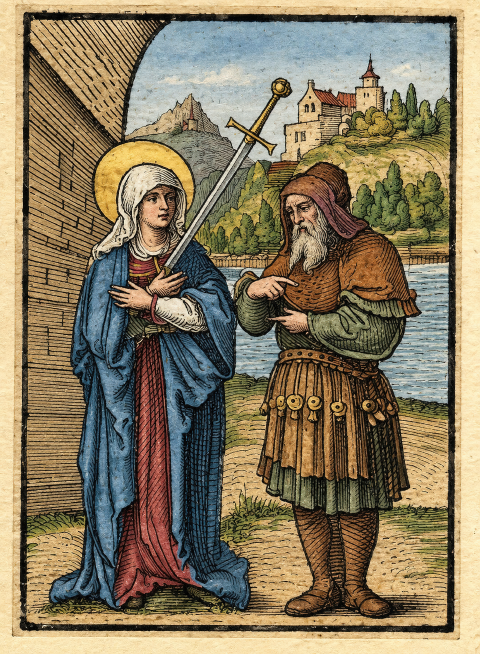
From this moment, her suffering was directly linked to Jesus’. Theologians also draw a link to John 19:25-27, where Mary is stood at the foot of the Cross:
“When Jesus saw His mother, and the disciple whom He loved standing by, He said to His mother, “Woman, behold your son!” Then He said to the disciple, “Behold your mother!” And from that hour that disciple took her to his own home.
John 19:25-27
St. Anselm of Canterbury, in the late 11th century, provides some of the earliest surviving literature focusing on Mary’s sufferings: 14
“My most merciful Lady, what can I say about the fountains that flowed from your most pure eyes when you saw your only Son before you, bound, beaten, and hurt?”
St. Anselm of Cantebury15
Traditionally, the modern devotion has been linked to the Order of the Servants of Mary. In 1239AD, the seven young founders began standing beneath the cross in imitation of Mary’s suffering as she looked upon her crucified Son.16
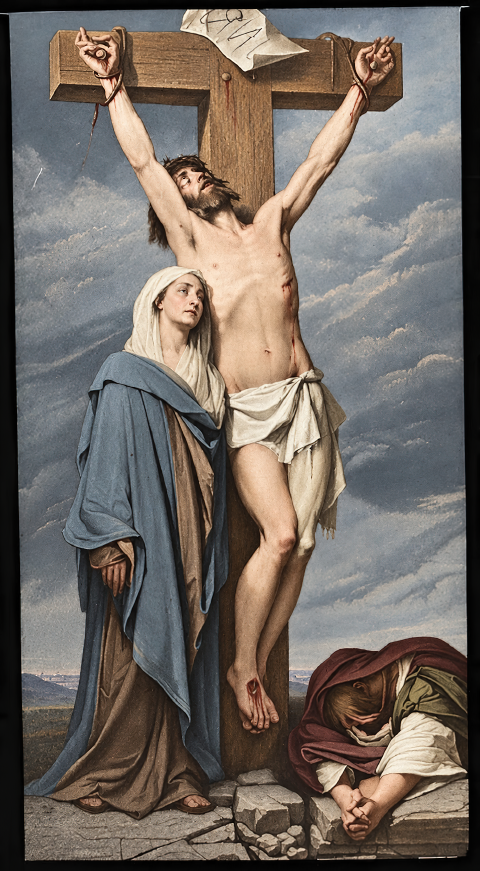
It is often claimed that the devotion was fully formed from this point. Instead, it appears to have developed more gradually, as the earliest churches linked to the Order are not named after Our Lady of Sorrows, which would have been expected.17
Early in the 15th century, there were local feasts focused on the devotion, under different names, such a “Transfixio” (meaning: “to be pierced”, a link to Luke 2:35), or “Compassio” (meaning: “fellow-suffering”). These earlier feasts focused exclusively on Mary’s pain when witnessing her Son’s suffering on the cross.17
By the end of that century, the devotion became focused on Seven Sorrows from Mary’s life. In 1482AD, Pope Sixtus IV promulgated the fest of the Seven Sorrows.13 It’s popularity grew, especially in central Europe.18
By the 16th century, under the Order of the Servants of Mary, it became widely established in Europe. Under Pope Clement IX, in 1668AD, the Servites were given another feast, called “The Seven Sorrows of the Blessed Virgin Mary”.
The first feasts, called “Tranfixio” or “Compassio”, were in 1727AD made into a feast for the whole Western Church by Pope Benedict XIII.16 Perhaps unhelpfully, it was also named “The Seven Sorrows of the Blessed Virgin Mary”!
In 1969AD, the two feasts, being essentially duplicates, were combined, and The Feast of Our Lady of Sorrows now falls on 15th September every year.
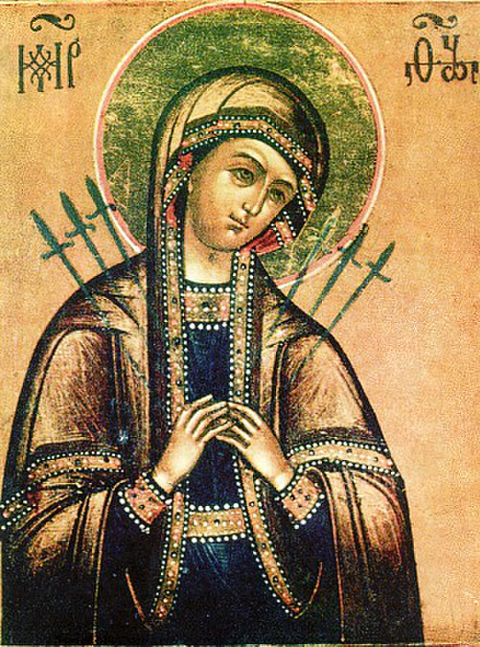
Devotion to Our Lady of Sorrows never gained official status in the East. Although a popular icon called Softener of Evil Hearts, probably made in south-west Russia towards the end of the 19th century,19 depicts Mary with seven swords piercing her heart. This is based on Mary’s Seven Sorrows.20
Sources #
1 Wright, D., 2016. The Revelations of Saint Bridget of Sweden. CreateSpace Independent Publishing Platform.
2 St. Mechthild of Hackeborn, 13th century. Liber Specialis Gratiae.
3 St. Alphonsus Liguori, 18th century. The Glories of Mary.
4 St. Bonaventure, 13th century. The Life of Christ.
5 St. Basil of Seleucia, 5thcentury. Homily 37, De infantibus.
6 Gray, I.K., 2017. The Search for Jesus’ Final Steps: How Archaeological and Literary Evidence Reroutes the Via Dolorosa (Doctoral dissertation, Towson University).
7 St. Cyril of Alexandria, 5th century. Commentary on John.
8 St. Bernard of Clairvaux, 12^th^ century. His Mother stood by the Cross.
9 St. Symeon Metaphrastes, 10^th^ century. Menologion.
10 Cruz, J.D., 1989. Prayers and Heavenly Promises. Imprimatur: Most Rev. Francis B. Schulte.
11 Ball, A., 2003. Encyclopedia of Catholic devotions and practices. Our Sunday Visitor.
12 Shaker, C., 2017. Sub Tuum Praesidium: a Reflection on the Protection of Mary, the Blessed Virgin Mother of God. Magistra, 23(2), pp.3-25.
13 Robles, S., 2005. Comme Femme Desconfortée: A Vision of Our Lady of Sorrows as a Disconsolate Woman. In International Congress on Medieval Studies.
14 Arvay, S.M., 2008. Private passions: The contemplation of suffering in medieval affective devotions. Rutgers The State University of New Jersey-New Brunswick.
15 St. Anselm of Canterbury, 11th century. “Prayer to Christ,” in The Prayers and Meditations of Saint Anselm with the Proslogion.
16 Holweck, F., 1912. Feasts of the Seven Sorrows of the Blessed Virgin Mary. The Catholic Encyclopedia, 14, pp.151-152.
17 Corradi, G., 2020. The Historical Evolution of the Marian Ideal of the Order of the Servants of Mary, in Particular, Considering Devotion to the Sorrows and Compassion of the Mother of Christ from 1233–1987. University of Dayton.
18 Schuler, C.M., 1992. The Seven Sorrows of the Virgin: popular culture and cultic imagery in pre-Reformation Europe. Simiolus: Netherlands Quarterly for the History of Art, 21(1/2), pp.5-28.
19 Bondarets, Y., 2022. CULTURE AND ART.
20 Bulgakov, S.N. and Bulgakov, S., 2008. Churchly joy: Orthodox devotions for the church year. Wm. B. Eerdmans Publishing.