 Catholica

What makes a catholic a Roman Catholic
? Papal primacy.
The Catholic understanding of papal primacy—the unique universal authority of the Bishop of Rome—is one of the major ecclesiological differences between Catholics, Protestants, and Eastern Orthodox Christians.
The Protestant reformer, John Calvin, once wrote: why Rome? And this sort of question is still very much asked today.
From the biblical case for Peter’s primacy to the witness of the early Church, apostolic succession, Rome, papal infallibility, and common Protestant objections, this guide explains the Catholic doctrine of papal primacy in one place.
Papal Primacy Definition #
Papal primacy, also known as the primacy of the Bishop of Rome, is a Christian ecclesiological doctrine concerning the respect and authority that is due to the Pope from other bishops and their episcopal sees.
The doctrine of papal primacy is all about the authority of the pope and the respect due to him.
The pope, exercising the office of St. Peter instituted by Jesus, possesses greater authority than any other bishop around the world.
This office of St. Peter is often called the chair of Peter, the Apostolic See, or the Holy See (see coming from the Latin sedes which literally means seat.)
Pope St. Gregory the Great (reigned 590-604 AD) popularised the title servant of the servants of God to describe the role of a pope, but he also writes elsewhere it is manifest that the Apostolic See is, by the ordering of God, set over all Churches. (Registrum Epistolarum, Book III, Letter 30)
Hence this link between authority and servanthood is an important aspect of papal primacy. A link confirmed by Jesus in Matthew 23:11, He that is the greatest among you shall be your servant.
While this verse sheds some light on the pope, it also explains why Jesus is, in reality, the head of the Church because He is (among other things) the greatest servant of all.
The pope, however, because of his role in occupying the chair of Peter, is the vicar of Christ (i.e. the lieutenant or earthly representative of Christ) and so, therefore, has the most authority on earth while Christ is in Heaven.
Summary: Papal primacy is the teaching that the pope has the highest earthly authority in the Church because he sits on the chair of St. Peter.
The Catechism describes the Pope, the Bishop of Rome and successor of St. Peter, as the “perpetual and visible principle and foundation of unity” of the bishops and faithful, and teaches that by virtue of his office he possesses “full, supreme and universal power over the whole Church.” This same teaching is summarized in Canon 331 of the Code of Canon Law.
Was a Visible Petrine Office Intended? #
A common Protestant objection is that the New Testament recognises bishops and deacons but never establishes a higher office of “pope”, and that Peter never explicitly claims such a position for himself. But the Catholic case does not depend on Peter adopting a later title. It depends on whether Scripture and the earliest Christian witnesses present him as holding a distinct leadership role within the apostolic college.
To say that there was never intended to be a visible hierarchical position in the Church is therefore a much bigger claim than it may first appear.
After all, in the Old Covenant, God established a priesthood with a head; the high priest. It cannot be completely out of the question, therefore, to assume that likewise in the New Covenant there is also a priesthood with a visible earthly leader.
Some Protestants believe that Christ just abolished that structure, yet there is no Scriptural or historical evidence, nor logical reasons for this.
Jesus himself said that he did not come to abolish, but to fulfill the Law (Matthew 5:17). The Scriptures clearly point towards St. Peter being the leader of the Apostles (Matthew 16:19, John 21:15-17, Matthew 10:2). Early Christians—people who were trained by the Apostles themselves—testify in the 1st and 2nd Century to papal primacy.
For example, in 200AD, Clement of Alexandria wrote, “The blessed Peter, the chosen, the preeminent, the first among the disciples, for whom alone with himself the Saviour paid the tribute [Matt. 17:27], quickly gasped and understood their meaning. And what does he say? ‘Behold, we have left all and have followed you.’”
Clement, writing in 221AD said, “Be it known to you, my lord, that Simon [Peter], who, for the sake of the true faith, and the surest foundation of his doctrine, was set apart to be the foundation of the Church, and for this end was by Jesus himself, with his truthful mouth, named Peter, the first fruits of our Lord, the first of the Apostles; to whom first the Father revealed the Son; whom the Christ, with good reason, blessed; the called, and elect.”
The great theologian St. Augustine of Hippo also had a similar understanding. In his commentary on John, he writes, “Who is ignorant that the first of the Apostles is the most blessed Peter?”
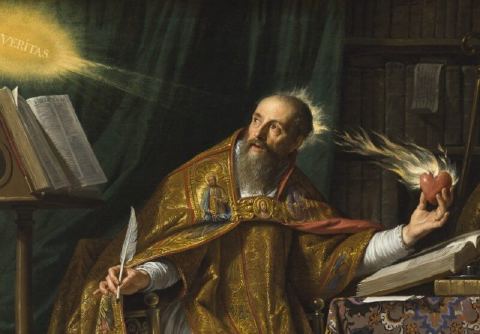
St. Augustine of Hippo, the famous early Christian theologian and philosopher from Numidia.
These are all people living about 100 years after the Apostles, in an almost identical culture, and where the Romans are persecuting Christianity—there was no reason to lie and no possibility for Roman corruption in the Church, therefore. Yet their view of St. Peter is crystal clear; St. Peter was the first among the Apostles.
Where Papal Authority Comes From #
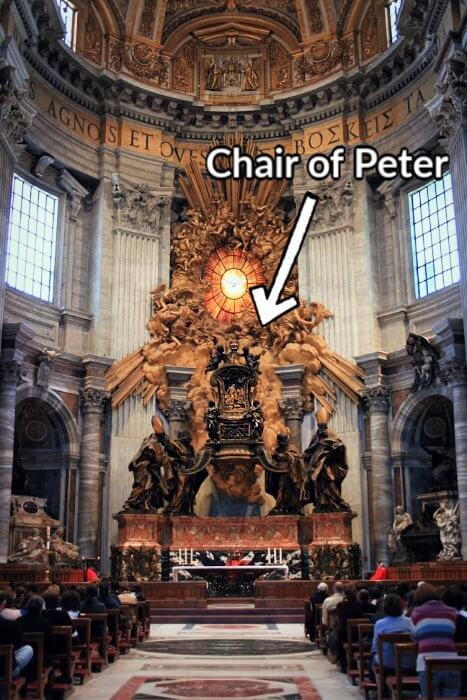
The relic of the chair of Peter in St. Peter’s Basilica, Vatican City. Source: Sergey Smirnov (Modifications made.)
Papal authority exists exclusively in the Chair of St. Peter—no chair, no authority.
This pattern also existed in the Old Testament with the chair of Moses mentioned in Matthew 23:2-3. According to Jesus, the Pharisees sat in that chair and that was what gave them authority. (Matthew 23:1-3)
The Chair of St. Peter, however, was invested with authority by Jesus Himself. (Matthew 16:18-19) And as the name suggests, the first occupant of the Chair of Peter was…St. Peter.
This is significant since it shows that popes don’t possess authority in of themselves, but the office itself carries that authority.
Therefore, when a pope dies or resigns, he loses that authority and an electee takes that seat, resuming his authority.
The process of a new pope succeeding one recently deceased is at the heart of the doctrine of apostolic succession.
That succession continues today with Pope Leo XIV, the 267th Pope and Bishop of Rome.
Primacy Does Not Mean a Pope Is Personally Impeccable #
Galatians 2 raises an obvious question: if Peter possessed primacy, how could Paul rebuke him publicly? The answer depends on distinguishing papal primacy from the idea that a pope is personally impeccable or incapable of making mistakes.
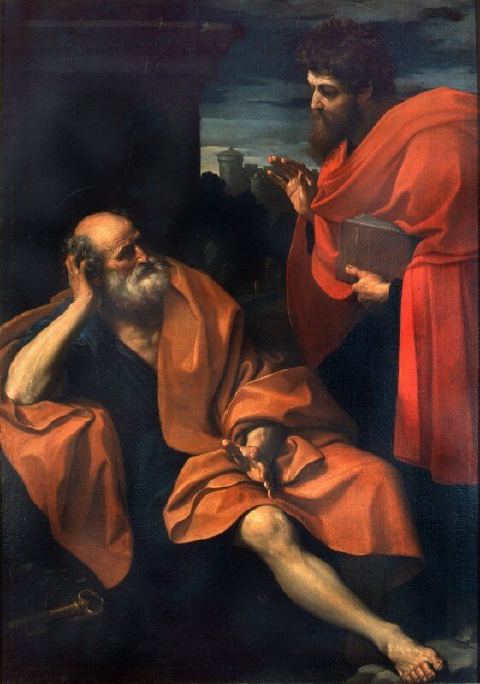
An early 17th Century painting by the high-Baroque Italian painter, Guido Reni, showing St. Paul rebuking the repentant St. Peter.
Nowhere does the Catholic Church teach that the Pope cannot ever be wrong. This is not what papal primacy entails. There have been many times where a Pope has said something that has later turned out to be false.
For example, in the 17th Century, Pope Paul V—for various reasons (and alongside other theologians, philosophers, and scientists at the time)—rejected Galileo’s theory that the Earth revolved around the sun. Obviously, it turns out he was wrong to maintain the Ptolemaic geocentric model which taught that the sun revolved around the Earth.
The Catholic Church does teach, however, that in very specific and unique circumstances, the Pope can speak without error. As paragraph 891 of the Catechism of the Catholic Church says, “The Roman Pontiff, head of the college of bishops, enjoys this infallibility in virtue of his office, when, as supreme pastor and teacher of all the faithful—who confirms his brethren in the faith he proclaims by a definitive act a doctrine pertaining to faith or morals.”
There are two key parts to this text: “by virtue of office” and “faith and morals”. I’ll briefly discuss the second of these points first.
According to the Catholic Church, the Pope, as Christ’s vicar on Earth, is able to proclaim the truth without error if it is on the subject of faith and morals. It also has to be said ex cathedra, meaning “from the chair”.
In Acts 15, the Apostles meet to discuss whether the new Christians needed to be circumcised. This was a matter of faith and morals. The Apostles did not get their Bibles out and debate and (inevitably) disagree with each other. Rather St. Peter, filled with the Holy Spirit and being preserved from error, proclaimed that circumcision is not necessary for the new Gentile Christians. The Apostles do not even question that he was right.
The Catholic understanding is that this is what happens not only in Acts 15 but in every subsequent Church council.
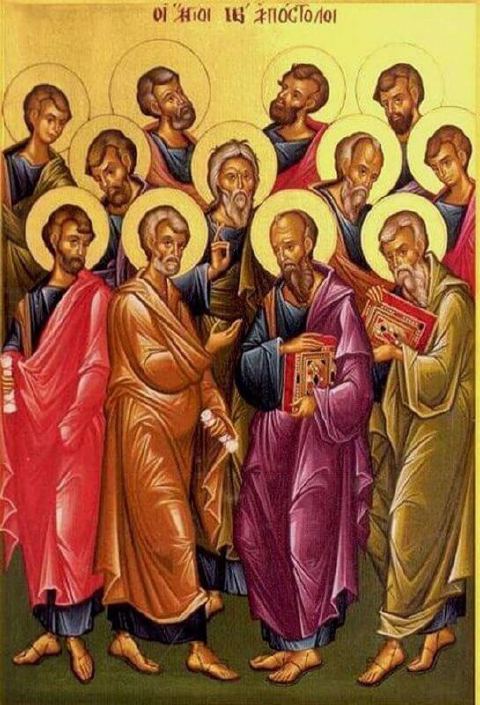
The Twelve Apostles…the Council of Jerusalem was undoubtedly the most star-studded cast of all Church councils!
The Catechism also notes that the Roman Pontiff enjoys this infallibility “in virtue of his office”. That is to say, the Pope was not infallible before he was ordained as Pope; before he becomes Pope, he does not have this ability.
Do we see any Scriptural evidence for this? Yes, I think we do.
In the Old Covenant, we know that God granted special graces to the priests, especially the high priest by virtue of office. For example, in John 11, John tells us that, “He did not say this on his own, but as high priest that year he prophesied that Jesus would die for the Jewish nation” (John 11:51). John here hints that because Caiaphas was high priest, he was able to prophesy.
In Matthew’s Gospel, Jesus tells us that the Pharisees were teaching authoritatively simply by virtue of sitting on Moses’ seat. “The scribes and the Pharisees sit on Moses’ seat, therefore, do whatever they teach you and follow it.” (Matthew 23:2-3a) Jesus says here that because Pharisees are in fact Pharisees, they have authority to teach.
Jesus goes on to say, “Do not do as they do, for they do not practice what they teach” (Matthew 23:3b). Christ is making it clear here that even though they are hypocrites, the Pharisees and scribes have authority to teach by virtue of office; i.e. that they “sit on Moses’ seat”. It is the same in the New Covenant, with the priests and high priest.
Peter’s Primacy in Scripture #
As well as apostolic succession, papal primacy requires the doctrine of St. Peter’s primacy to stand.
Without either, the doctrine of papal primacy falls.
According to the early Church Fathers, there is an abundance of scriptural proof showing that St. Peter’s authority surpassed that of the other disciples of Jesus.
While the Church Fathers comment on many scriptures regarding St. Peter’s supremacy, some key passages include Matthew 16:18-19, John 21:15-17, and Luke 22:31-32.
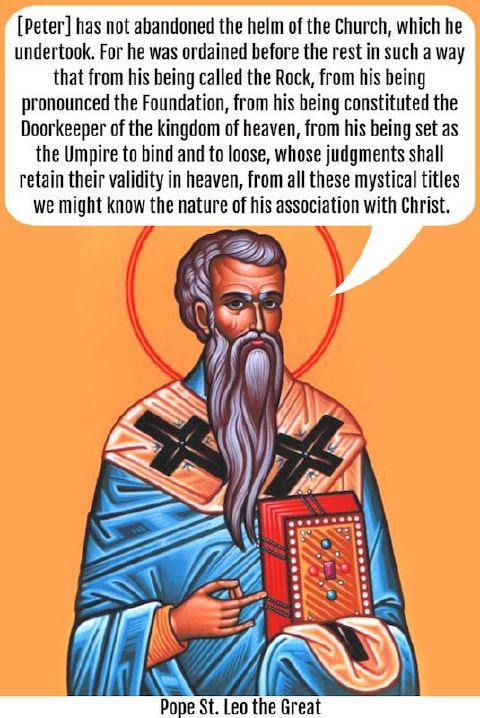
Here are the thoughts of Pope St. Leo the Great on Matthew 16:18, St. John Chrysostom on John 21:15, and St. Augustine on Luke 22:31-32 respectively.
St. Leo the Great on Matthew 16:18 #
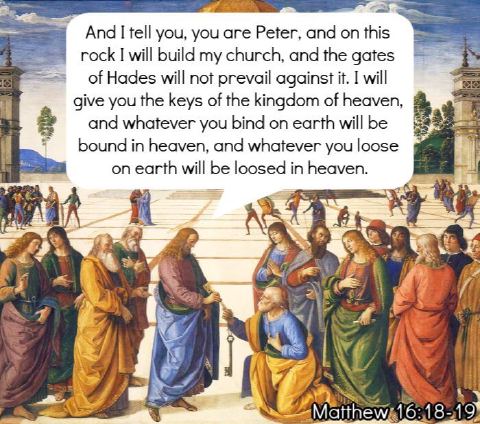
…the universal Church has become a rock through the building up of that original Rock, and the first of the Apostles, the most blessed Peter, heard the voice of the Lord saying, You are Peter, and upon this rock I will build My Church
—Pope St. Leo the Great, Letter 156, paragraph 2
Here Pope St. Leo I (400–461 AD) calls St. Peter the first of the Apostles while seeming to identify that original Rock with Peter. By doing so, he shows the cause and effect of St. Peter’s building up and the solidity of the whole Church.
St. Leo’s observation carries on Matthew 16:18’s wordplay with Peter’s name since, in Greek, Peter is Πέτρος (Petros), which means rock.
…the building up of that original Rock seems to be referring to St. Peter’s confession in Matthew 16:13-20, Mark 8:27–30 and Luke 9:18–20, as well as Jesus’ prayer for St. Peter’s faith in Luke 22:31-32.
Because of this, St. Peter is able to strengthen his brothers (Luke 22:32) and tend to Christ’s flock in a unique way. (John 21:16)
In summary, St. Peter must have primacy since he is the first of the Apostles and his faith’s strength is linked to the strength of the whole Church.
St. John Chrysostom on John 21:15 #
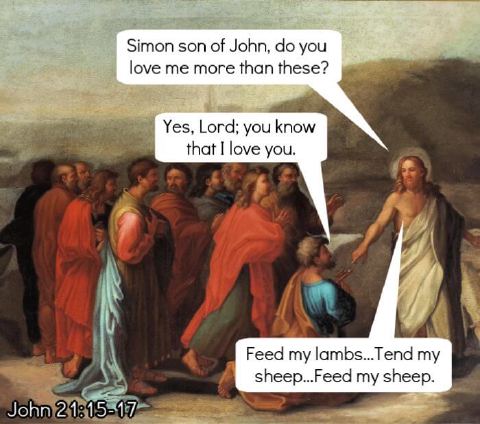
He [Jesus] says unto him, Feed My sheep. And why, having passed by the others, does He speak with Peter on these matters? He was the chosen one of the Apostles, the mouth of the disciples, the leader of the band; on this account also Paul went up upon a time to enquire of him rather than the others…Jesus puts into his [Peter’s] hands the chief authority among the brethren
—St. John Chrysostom, Homily 88 on the Gospel of John
St. John Chrysostom (347–407 AD) notes that Jesus passed by the others when pinpointing Peter as the chosen one of the Apostles to feed Christ’s flock.
Moreover, throughout the Gospels and Acts, Peter repeatedly appears as a spokesman for the Twelve Apostles, which is consistent with John Chrysostom’s description of him as “the mouth of the disciples.”
But the simple reason that Jesus passed by the others is that Peter has the chief authority among the brethren. And this is why Paul visited him above all others in Galatians 1:18 and stayed with him 15 days.
In summary, St. Peter must have primacy since he has the chief authority among the brethren, having been the only one charged by Jesus to feed his sheep.
St. Augustine on Luke 22:31-32 #
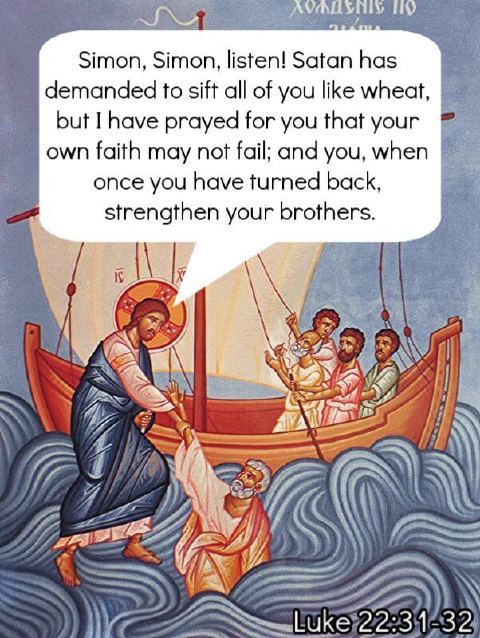
He [Jesus] said in the same place of the Gospel, This night has Satan desired to sift you as wheat, and I have prayed for you, Peter, that your faith fail not. He that defends prays, and shall not he pray who is in peril? For in the words of the Lord, when the Son of Man shall come, do you think that He shall find faith on the earth? He spoke of that faith, which is perfect.
—St. Augustine, Sermon 65 on the New Testament, paragraph 1
While St. Augustine mostly lets this scripture speak for itself, he does highlight the relationship between prayer and the defense of the faith while also reflecting on Jesus’ desire for perfect faith in Luke 18:8.
If Jesus, desiring perfect faith from his disciples, singles out Peter by exclusively praying for his faith, then is it any surprise that Jesus would also single him out to tend his flock?
In summary, it is logical for St. Peter to be the prime apostle since he is the apostle best equipped by Jesus to inspire perfect faith in others since his faith will fail not.
Why Didn’t Jesus Simply Call Peter the Greatest? #
Luke 22:24-34 presents another natural question. When the disciples dispute about which of them is the greatest, why does Jesus not simply settle the matter by announcing that Peter will be the first earthly father or leader of the Church?
It is true that Jesus never explicitly states that St. Peter is the “first Father of the Church.” However, neither does he explicitly state many things that are nonetheless true.
For example, he does not state that He is the 2nd person of the Holy Trinity or—in fact—that the Trinity exists at all, but it is nonetheless true. It is however implied, and papal primacy is the same here.
Jesus response in Luke 22:24-34 is about being the greatest in the sense of service; it is not concerned with worldly hierarchy, and the two should not be mixed.
For example, Jesus himself is said to have “made himself nothing, taking the form of a servant” (Philippians 2:7), yet this in no way detracts from his authority in the Church.
Jesus tells us that, “The greatest among you must become the youngest, and the leader like one who serves” (v26). He then goes on in the same passage, singling out Simon St. Peter, saying: “Strengthen your brothers and sisters” and, also, that St. Peter’s “faith will not fail”.
Thus Jesus models true servant leadership and specifically instructs St. Peter to do the same. He, therefore, implies St. Peter’s primacy in instructing St. Peter to be the greatest servant of them all.
Pope St. Gregory I (pope from 590 to 604) was the first pope to use the phrase “servant of the servants of God” to refer to himself and, after the 12th Century, the title came to be used exclusively for the Pope.
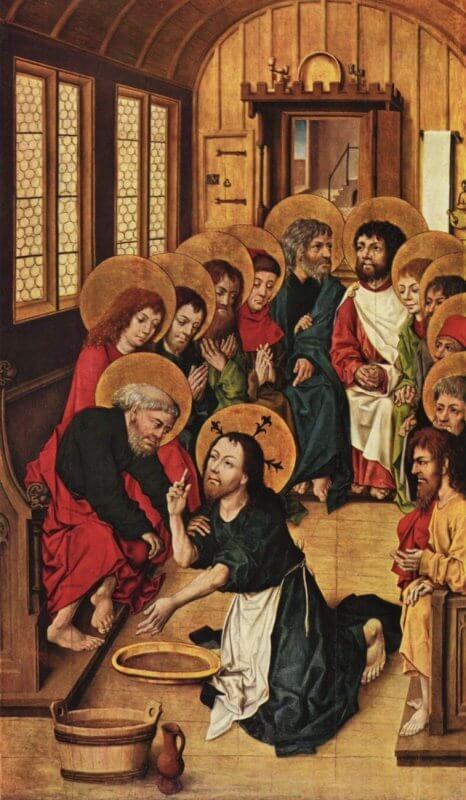
“Christ Washing the Feet of the Apostles” by the unknown painter called the “Master of the Amsterdam Cabinet”. Painted 1475AD.
There are other examples in Scripture where St. Peter’s primacy is more clearly demonstrated. For example, St. Peter (and St. Peter alone) is specifically given the keys to the kingdom of heaven (Matthew 16:19), as well as being the only disciple charged to feed Christ’s lambs and sheep, which included the 11 other Apostles (John 21).
As well as this, St. Peter is made the rock on which the Church is built upon (Matthew 16:18). Moreover, every time the names of the Apostles are listed, except for Galatians 2:9, St. Peter’s name appears first. In Matthew 10:2 it explicitly says that St. Peter is first. It is also St. Peter who chooses a replacement for Judas Iscariot. No other disciple is given these specific leadership duties.
Is the Rock Peter, His Faith, or Jesus? #
(Hint: It’s all 3!)
Oftentimes, we can automatically assume an either/or approach to biblical interpretation instead of a both/and approach.
The question of whether Jesus is identifying the rock in Matthew 16:18 as Peter’s faith or Peter himself is one such instance where a both/and approach is instructive.
This is because the Church Fathers identify the rock as Peter as well as his confession of faith. (They also point out that Jesus is the rock; a fact neither Catholics nor Protestants would disagree with.)
These varied interpretations are valid, plain readings of the text and shouldn’t be seen as contradictory.
However, for the purpose of this post, here are a few Church Father quotes that show their interpretation of Peter being the rock.
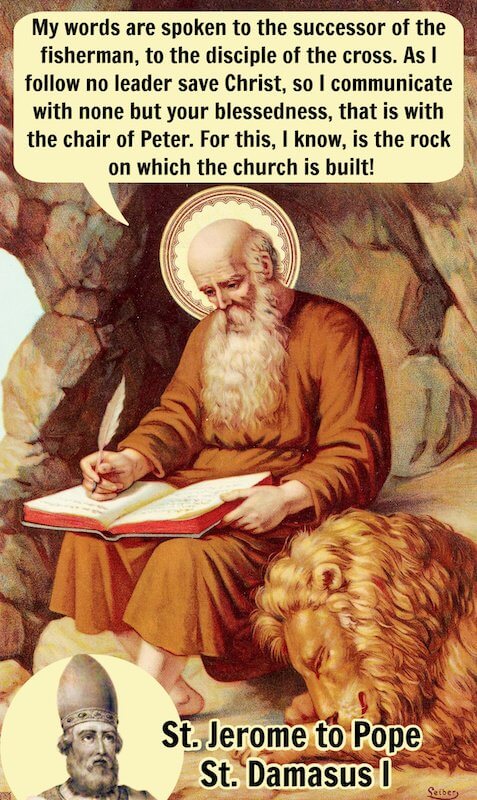
Letter to Pope Damasus I (377 AD), paragraph 2
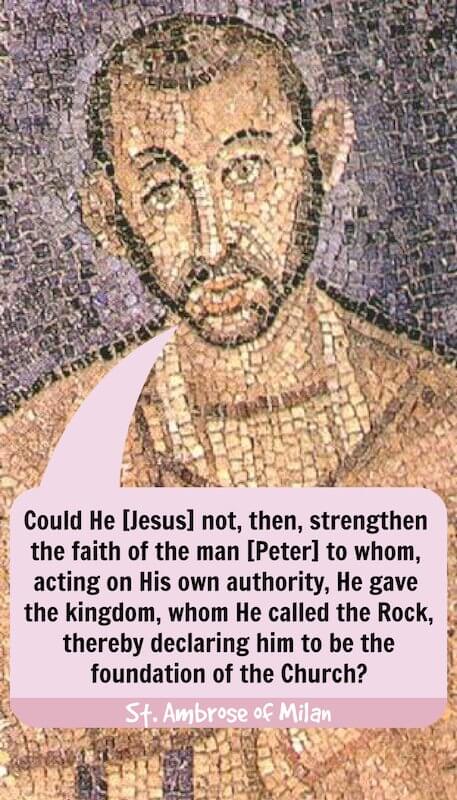
Exposition of the Christian Faith, book 4, paragraph 57
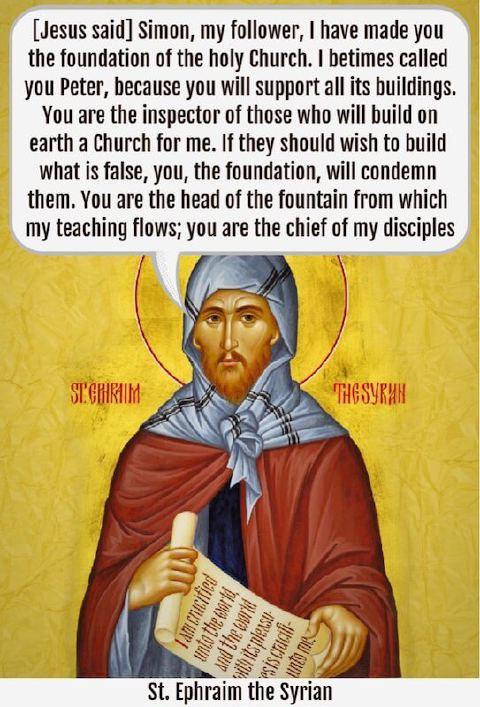
Homilies 4:1 (351 AD) — not available online in English
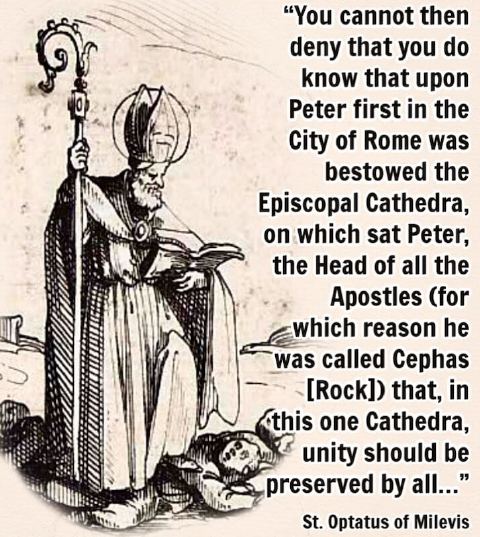
Against the Donatists, book 2, section 2
A linguistical objection to Peter being the rock is the Greek word used for Peter’s name in Matthew 16:18—Πέτρος (Petros)—and the Greek word used for rock—πέτρα (Petra)—in the term on this rock later on in the verse.
Some say by this that if Jesus was identifying the rock with Peter, then the text would use the same word each time. Since, for example, Jesus is called the petra in 1 Corinthians 10:4 when it says the rock was Christ.
While there are multiple ways to resolve this seeming linguistical problem, the simplest explanation is found as follows:
- Petros is the masculine version of Petra.
- Peter was given a name change by Jesus in Matthew 16:18 from Simon to Petros.
- It was appropriate for Peter to have a male name since he’s male.
- 1 Corinthians 10:4 which says the petra was Christ is acceptable because it’s not changing Jesus’ name to petra but making a theological point.
The identification of Peter as the rock is also a view shared by theologians, including the Protestant theologian Robert McAfee Brown who says,
Protestants are learning that the crucial passage in Matthew 16 about the rock on which the church will be built almost certainly refers to Peter himself rather than to his faith.
While I personally feel Robert McAfee Brown is a bit too restrictive in his assessment of Matthew 16:18 (the Church Fathers believe the rock to be Peter, his faith, and Jesus), it nonetheless shows how the Catholic view is reasonable.
This also answers a common either/or objection: if Jesus is the foundation of the Church, how can Peter also be called its rock? Catholic theology readily affirms that Jesus is the Church’s ultimate foundation. The claim about Peter is subordinate to that truth: in Matthew 16:18, Christ himself gives Simon the name Peter and speaks of building his Church on “this rock.” Calling Peter the rock therefore does not displace Christ; it describes a role Christ gives him within the Church Christ himself builds.
Was Peter the First Pope? #
The word pope comes from the Greek word πάππας (páppas); an affectionate term for father similar to our term papa today.
Páppas came to refer to bishops and patriarchs and, in the Latin Catholic Church, eventually became the customary title of the Bishop of Rome. Some non-Catholic Christian patriarchs, including the Coptic Orthodox Pope of Alexandria, also retain the title.
Resultingly, Peter being the first bishop in Rome meant that he was also the first pope (using the modern meaning of the term.)
Does Peter’s Marriage Conflict with Clerical Celibacy? #
Peter’s marriage is sometimes raised as an objection to the papacy: if Peter had a wife, does that undermine the later Latin discipline of clerical celibacy?
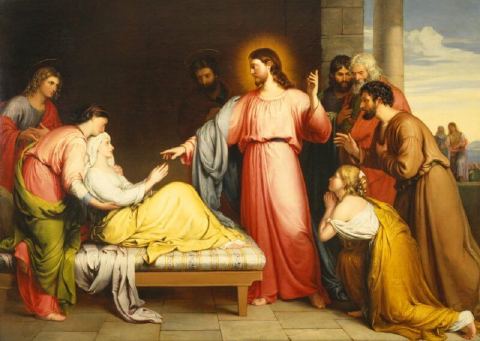
“Christ Healing the Mother of Simon Peter’s Wife” by John Bridges, 1839AD.
It does not. The Catholic Church does not teach that every clergyman must be celibate because the Apostles were. As this objection itself points out, not all of the Apostles were celibate.
However, it wasn’t until the 11th Century that priests were expected to be celibate. The reason was that priests were behaving immorally, so the Pope made it mandatory that Priests are celibate.
This was to follow St. Paul’s advice where he says it is easier to give your undivided attention to the Lord if you are single (1 Corinthians 7).
Therefore, the Pope’s requirement of celibacy does not collapse. It is just a practical suggestion for clergy and, some may argue, necessary for other practical reasons.
Did Peter Go to Rome? #
But wait…did Peter even go to Rome? Yes, he did.
And we know this mainly due to history and slightly due to Scripture.
Peter sends greetings from “Babylon” in 1 Peter 5:13, a name that early Christian interpretation has often understood symbolically as Rome.
But the historical evidence for Peter being in Rome is what settles the case.
Widely corroborated tradition places Peter in Rome for three reasons:
- Him founding the Church in Rome with St. Paul.
- Him being the first Bishop of Rome.
- Him dying there.
If Scripture Doesn’t Call Peter Bishop of Rome, Why Believe It? #
Scripture does not explicitly say, “Peter was Bishop of Rome.” That absence is often raised against the Catholic claim. But Scripture records only part of Peter’s life, so the fact that a later event or office is not narrated in the New Testament does not by itself show that it never happened.
It is true that Scripture does not tell us that St. Peter was bishop of Rome, but that is because Scripture only records part of St. Peter’s life; if something is not in Scripture, it doesn’t mean it is automatically not true.
For example, it would be wrong to say, “It is not true that many of the Apostles were martyred because there is no Scriptural evidence for it”. We know that the Apostles were martyred because there is historical evidence outside the Bible for it. The same can be said about St. Peter and Rome.
St. Irenaeus of Lyons, halfway through the 2nd Century writes, “The very ancient, and universally known Church founded and organized at Rome by the two most glorious Apostles, Peter and Paul.”
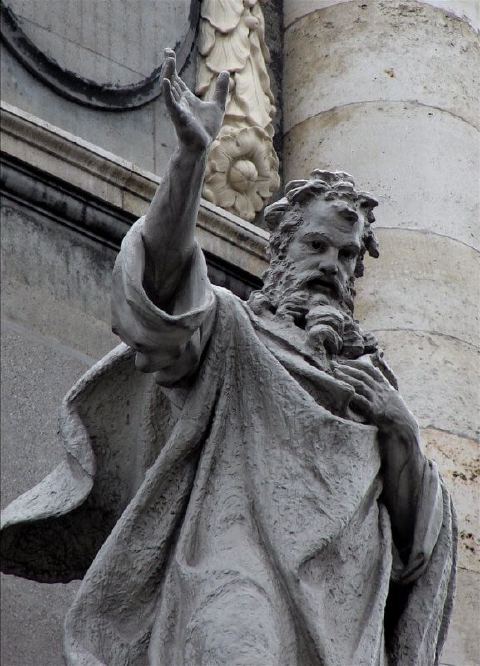
A 19th Century statue of the 2nd Century Greek cleric, St. Irenaeus of Lyon, located in the Frederiksstaden district of Copenhagen, Denmark.
In 190AD, Clement of Alexandria wrote, “Peter had preached the Word publicly at Rome.”
I could also quote Jerome, Eusebius, and Clement. The evidence seems to be clear; St. Peter definitely went to Rome, and being an Apostle, the historical data strongly supports the claim that he was a bishop too.
Who Succeeded Peter as Pope? #
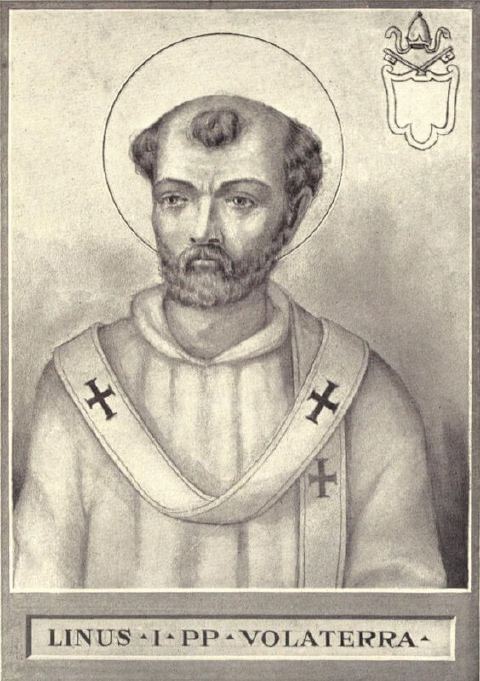
The 2nd bishop of Rome was St. Linus who was pope for roughly 12 years.
He’s mentioned by St. Paul in 2 Timothy 4:21 and was the first Roman-born pope of many.
Linus being the 2nd bishop of Rome is confirmed by various Church Fathers.
…the blessed apostles, then, having founded and built up the Church, committed into the hands of Linus the office of the episcopate.
—St. Ireneaus of Lyon, Against Heresies, book 3, chapter 3, paragraph 3
[Linus was] the first after Peter to be in charge of the Roman Church.
—St. Jerome, Chronicon, 14g
After the martyrdom of Paul and of Peter, Linus was the first to obtain the episcopate of the church at Rome. Paul mentions him, when writing to Timothy from Rome, in the salutation at the end of the epistle.
—Eusebius of Caesarea, Church History, book 3, chapter 2
Apostolic Succession List #
Below is an apostolic succession list of all the popes from St. Peter to the present day.
Peter’s Primacy in Tradition & History #
While the early Church Fathers point to Scripture, they also state it as if it were some commonly-known fact of the early Church.
26. Go your way, therefore, to my brethren — that is, to those everlasting doors, which, as soon as they see Jesus, are lifted up. Peter is an everlasting door, against whom the gates of hell shall not prevail. Matthew 16:18 John and James, the sons of thunder, to wit, Mark 3:17 are everlasting doom. Everlasting are the doors of the Church, where the prophet, desirous to proclaim the praises of Christ, says: That I may tell all your praises in the gates of the daughter of Sion. – 26, Chapter 2, Book IV, Exposition of the Christian Faith, St. Ambrose
57. Moreover, that you may know that it is after His Manhood that He entreats, and in virtue of His Godhead that He commands, it is written for you in the Gospel that He said to Peter: I have prayed for you, that your faith fail not. Luke 22:32 To the same Apostle, again, when on a former occasion he said, You are the Christ, the Son of the living God, He made answer: You are Peter, and upon this Rock will I build My Church, and I will give you the keys of the kingdom of heaven. Matthew 16:18 Could He not, then, strengthen the faith of the man to whom, acting on His own authority, He gave the kingdom, whom He called the Rock, thereby declaring him to be the foundation of the Church? Consider, then, the manner of His entreaty, the occasions of His commanding. He entreats, when He is shown to us as on the eve of suffering: He commands, when He is believed to be the Son of God. – 57, Chapter 5, Book IV, Exposition of the Christian Faith, St. Ambrose
1. Who, then, is a faithful and wise servant, whom his lord has made ruler over his household, to give them meat in due season? Blessed is that servant, whom his lord when he comes shall find so doing. Matthew 24:45-46 Not worthless is this servant: some great one ought he to be. Let us think who he may be. 2. It is Peter, chosen by the Lord Himself to feed His flock, who merits thrice to hear the words: Feed My little lambs; feed My lambs; feed My sheep. And so, by feeding well the flock of Christ with the food of faith, he effaced the sin of his former fall. For this reason is he thrice admonished to feed the flock; thrice is he asked whether he loves the Lord, in order that he may thrice confess Him, Whom he had thrice denied before His Crucifixion. – 1 and 2, Prologue, Book V, Exposition of the Christian Faith, St. Ambrose
146b. See, then, in Peter God wrought the grace of preaching. And who would dare to deny the operation of Christ in him, since he was certainly elected and chosen by Christ, when the Lord said: Feed My lambs. John 21:15. 147. The operation, then, of the Father, the Son, and the Holy Spirit is one, unless perchance you, who deny the oneness of the same operation upon the Apostle, think this; that the Father and the Spirit wrought in Peter, in whom the Son had wrought, as if the operation of the Son by no means sufficed for him to the attainment of the grace. And so the strength of the Father, of the Son, and of the Holy Spirit being as it were joined and brought together, the work was manifold, lest the operation of Christ alone should be too weak to establish Peter. 148. And not only in Peter is there found to be one operation of the Father, the Son, and the Holy Spirit, but also in all the apostles the unity of the divine operation, and a certain authority over the dispensations of heaven. – 146-148, Chapter 13, Book II, On the Holy Spirit, St. Ambrose *The Trinity established Peter (as well as all the apostles.)
158. Nor was Paul inferior to Peter, though the latter was the foundation of the Church, and the former a wise builder knowing how to make firm the footsteps of the nations who believed; Paul was not, I say, unworthy of the fellowship of the apostles, but is easily comparable with the first, and second to none. For he who knows not that he is inferior makes himself equal. – 158, Chapter 13, Book II, On the Holy Spirit, St. Ambrose *The Trinity established Peter (as well as all the apostles.)
123. Because Peter believed this, he received the keys of the kingdom of heaven, and without anxiety for himself forgave sins. – 123, Chapter 17, Book III, On the Holy Spirit, St. Ambrose
“The blessed Peter, the chosen, the preeminent, the first among the disciples…” — St. Clement of Alexandria, “Who Is the Rich Man That Is Saved?” 21:3–5 [A.D. 200].
And in fact, many of the Protestant reformers a thousand years later also hold to Peter’s primacy.
Did the Catholic Church Begin in the Fourth Century? #
A broader historical challenge claims that the Church of Rome did not really emerge until the fourth century and that, for the preceding centuries, Christians simply followed the teaching of the Apostles without anything resembling Catholic apostolic succession. If that were true, tracing the papacy back to Peter would indeed be difficult.
The question, then, is whether recognisably Catholic features actually appear before the fourth century. To test that claim, we can look at the features that most clearly distinguish Catholic ecclesiology and sacramental life, then ask how early they appear in Christian sources.
For the purposes of this, I’ll take a handful of absolutely distinctive features that can only identify as Catholic. There are the absolute fundamentals of Christianity, such as Christ’s nature, the reality of his death and resurrection, but we both agree on those doctrines, so I’ll focus on the distinctly Catholic features of the early Church.
These include:
- a hierarchical church structure with clergy having apostolic succession,
- a belief that all Church councils are guided infallibly by the Holy Spirit,
- a belief in the real presence of Christ at the Eucharist,
- a belief in the baptismal washing away of sins,
- and the belief in confession.
All other dogmas, such as Purgatory and the Marian doctrines are not as elementary as these points, and hence the Church defined them far later in Church history.
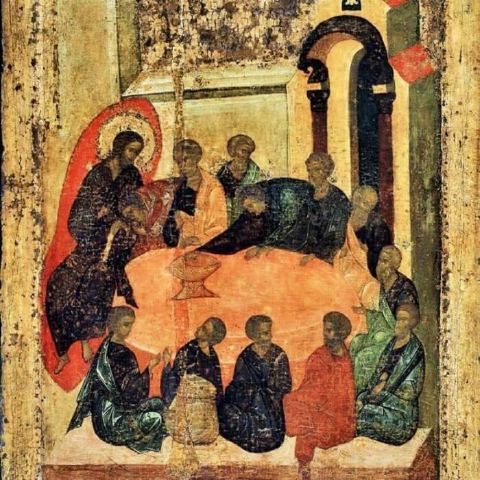
Was the early church “Catholic”?
The first feature was Church hierarchy. Did this feature exist before the 4th Century? It did. In fact, it existed one generation after the Apostles, as is clear in the writings of St. Ignatius of Antioch, who himself was a disciple of the Apostle John.
St. Ignatius wrote 7 letters as he was being brought to Rome to be martyred by the Romans in around 100AD. To use just one quote, in his letter to the Trallians, St. Ignatius says, “In like manner, let all reverence the deacons as an appointment of Jesus Christ, and the bishop as Jesus Christ, who is the Son of the father, and the presbyters as the Sanhedrin of God, and assembly of the Apostles. Apart from these, there is no Church.”
This quote clearly shows the three different offices of the early Church. It is clearly demonstrated. In fact, St. Ignatius writes to 7 different Churches across the world, and they all have this hierarchy.
The next feature is apostolic succession; did these clergymen have apostolic succession from the original Apostles? Again the testimony of the early Church clearly shows that they believed this.
In 80AD, St. Clement of Rome writes, “Through countryside and city [the Apostles] preached, and they appointed their earliest converts, testing them by the Spirit, to be the bishops and deacons of future believers. Nor was this a novelty, for bishops and deacons had been written about a long time earlier…Our Apostles knew through our Lord Jesus Christ that there would be strife for the office of bishop. For this reason, therefore, having received perfect foreknowledge, they appointed those who have already been mentioned and afterwards added the further provision that, if they should die, other approved men should succeed to their ministry.”
St. Clement, who is writing 47 years after Jesus’ death is telling us that the Apostles appointed people as bishops, and then when they died, they were succeeded by others. There isn’t a good reason to doubt this.
In fact Acts 6:6 mentions appointing St. Stephen as a leader through the laying on of hands, and the New Testament epistles are flooded with reference to appointing leaders. We have no reason to doubt Clement, therefore.
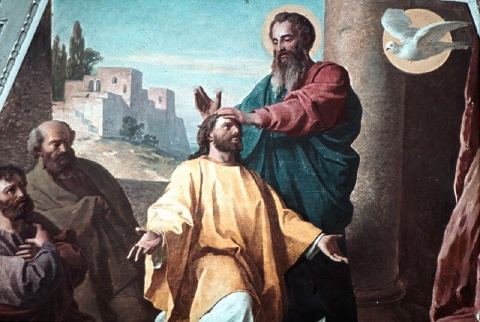
An artist’s interpretation of St. Paul ordaining St. Timothy.
So far then, within the 1st Century, we have bishops, presbyters (which can be translated as elder or priest) and deacons, and they can trace their appointment back to the Apostles. In other words, there is apostolic succession (more on that topic here).
The next feature is the belief that the Holy Spirit guides the Church councils infallibly. Since the first Church Council, the Council of Jerusalem, is recorded in the book of Acts, it makes sense to start there.
At this council, the issue was over the necessity of the Mosaic Law for new Christian believers, and in particular the issue of circumcision. After the council has been settled, and it has been decided that circumcision is not necessary, there is simply no debate on the matter, but why is this?
I would argue that it is because the Apostles believed that their discussions were led by the Holy Spirit, and once the issue had been settled, the Apostles did not even question the validity of their decision.
St. Peter is rebuked by St. Paul because he compromises, not because he disagrees with the council. This again is in line with what Jesus says in John 16:13, “But when he, the Spirit of truth, comes, he will guide you into all the truth. He will not speak on his own; he will speak only what he hears, and he will tell you what is yet to come.”
According to Jesus, the Holy Spirit will guide the Apostles into all truth, and therefore also to his successors. It wasn’t as if the Holy Spirit only led the Apostles, then withdrew from the world. It is also untrue, as many Protestants claim, that Jesus is saying he will lead all people into all truth, and all churches.
The reason this cannot be true is that there are approximately 40,000 different Protestant denominations, all claiming that the Holy Spirit has led them, but they all have different interpretations, which contradict with other Protestant interpretation. They cannot all be correct since it is fallacious to say contradictory positions can simultaneously be true.
In addition to the apostolic age, an identical pattern is seen with other councils. That is, when a council has approved or defined a certain doctrine and condemned another understanding as heretical, that is simply the end of the matter. As St. Augustine of Hippo said, “Rome has spoken, the matter is ended.”
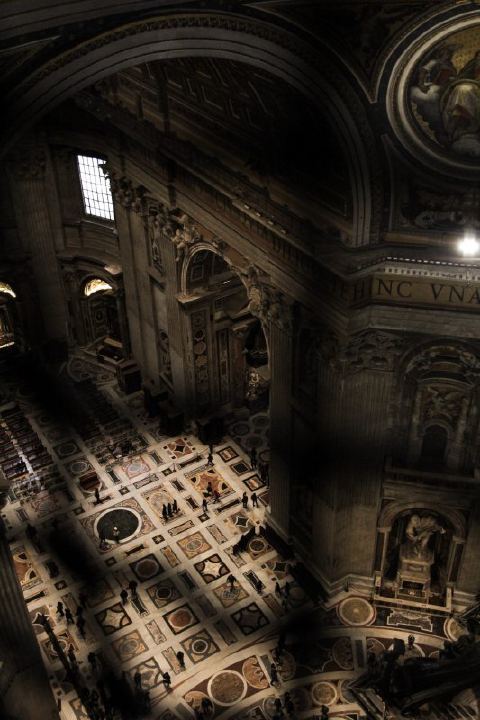
St. Peter’s Basilica in Vatican City.
The next feature I will discuss is the real presence of Christ in the Eucharist. A great Biblical defense could be made here, however, in this response, I will quickly show how the early Church of the 1stCentury firmly, and even aggressively affirmed Christ’s presence in the Eucharist. In his letter to the Smyrneans, St. Ignatius of Antioch writes, “They abstain from the Eucharist and from prayer, because they confess not the Eucharist to be the flesh of our Saviour Jesus Christ, which suffered for our sins, and which the Father, of His goodness, raised up again. Those, therefore, who speak against this gift of God, incur death in the midst of their disputes.”
As mentioned earlier, St. Ignatius is either writing at the end of the 1st Century or at the very beginning of the 2nd. Elsewhere, St. Ignatius refers to the Eucharist as “the medicine of immortality and the antidote against death, enabling us to live forever in Jesus Christ”. Not only does he believe that Christ really is present in the bread and wine, but he aggressively defends it, saying that the heretics (who in this case are docetists) are heretics by virtue of the fact that they do not believe the Eucharist to be Christ’s body.
St. Justin Martyr, writing in around 165AD said, “For we do not receive these things as common bread or common drink; but as Jesus Christ our Saviour being incarnate by God’s Word took flesh and blood for our salvation, so also we have been taught that the food consecrated by the Word of prayer which comes from him, from which our flesh and blood are nourished by transformation, is the flesh and blood of that incarnate Jesus”.
It can be concluded that the early Church, within 100 years of Christ’s death, believe the Eucharist to be the real presence of Christ.
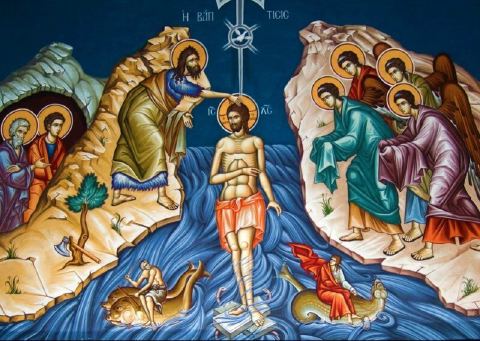
The icon of the baptism of Jesus.
The early Church also believed that baptism washed away sins. St. Irenaeus in the 2nd Century writes, “And dipped himself, says [the Scripture], ‘seven times in Jordan.’ It was not for nothing that Naaman of old, when suffering from leprosy, was purified upon his being baptized, but it served as an indication to us. For as we are lepers in sin, we are made clean, by means of the sacred water and the invocation of the Lord, from our old transgressions; being spiritually regenerated as new-born babes, even as the Lord has declared: ‘Except a man be born again through water and the Spirit, he shall not enter into the kingdom of heaven.’”
The early Church also taught the necessity of baptism, as does St. Peter in 1 Peter 3:21.
The final Catholic feature I mentioned is confession. There is a very strong reference to confession in John 20:21-23: “Again Jesus said, “Peace be with you! As the Father has sent me, I am sending you.” And with that he breathed on them and said, “Receive the Holy Spirit. If you forgive anyone’s sins, their sins are forgiven; if you do not forgive them, they are not forgiven.”
Jesus here is speaking to the Apostles after his resurrection and is giving them his own authority to forgive sins. Here he institutes the sacrament of confession, whereby people confess their sins to the Apostles and, in the future, to their successors, and they are able to forgive sins, not in their own strength, but by the breath of God, which Jesus gave when he breathed on the Apostles.
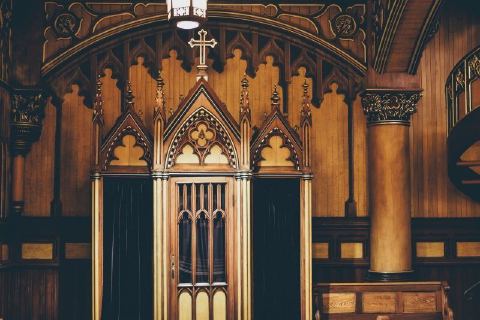
A confessional booth in Notre-Dame Basilica in Montréal, Canada.
This understanding is also testified in the early Church by Hippolytus, writing early in the 3rd Century: “[The bishop conducting the ordination of the new bishop shall pray:] God and Father of our Lord Jesus Christ. Pour forth now that power which comes from you, from your royal Spirit, which you gave to your beloved Son, Jesus Christ, and which he bestowed upon his holy Apostles and grant this your servant, whom you have chosen for the episcopate, [the power] to feed your holy flock and to serve without blame as your high priest, ministering night and day to propitiate unceasingly before your face and to offer to you the gifts of your holy Church, and by the Spirit of the high priesthood to have the authority to forgive sins, in accord with your command.”
To conclude this whole response then, I would disagree that the Catholic Church began in the 4th Century. The 1st Century and 2nd Century church had very Catholic characteristics.
They believed in a hierarchical church structure, with clergyman having apostolic succession back to the Apostles, they believed that Church councils were led infallibly by the Holy Spirit, they believed in the real presence of Christ in the Eucharist, they believed that baptism washed away sin, and they believed that the Apostles and their successors could forgive sins through Christ.
I would conclude by suggesting that this Church was, in fact, the Catholic Church. One could argue that this Church is different from the one seen in Scripture. After all, I’ve only argued that the generation after the Apostles were Catholic.
However, that argument is highly unlikely—after all, how could everything have gone so wrong a mere few decades after Christ? Further, this line of thinking is not even Biblical. Christ says that the gates of hell shall never prevail against the Church (Matthew 16:18), St. Paul says that the Church is the pillar and foundation of truth (1 Timothy 3:15).
If someone were to argue that the Church started off well, and then immediately became corrupt is to say that the gates of hell did prevail against the Church and, therefore, that it is not the pillar and foundation of truth. That is to contradict Scripture.
It is far more reasonable to say that the Church did not teach heresy, but that it was guarded by the Holy Spirit, and preserved from error. That Church is the Catholic Church, and the promise remains true today.