 Catholica

Have you ever seen Catholics make a cross gesture with one of their hands? Well, it’s called making the Sign of the Cross—a short prayer Catholics trace on themselves while naming the Father, the Son and the Holy Spirit.
It takes about three seconds, and it is the first prayer most Catholics learn. Here is how to do it, the words to say, and what the gesture means.
How to Make the Sign of the Cross on Your Body #
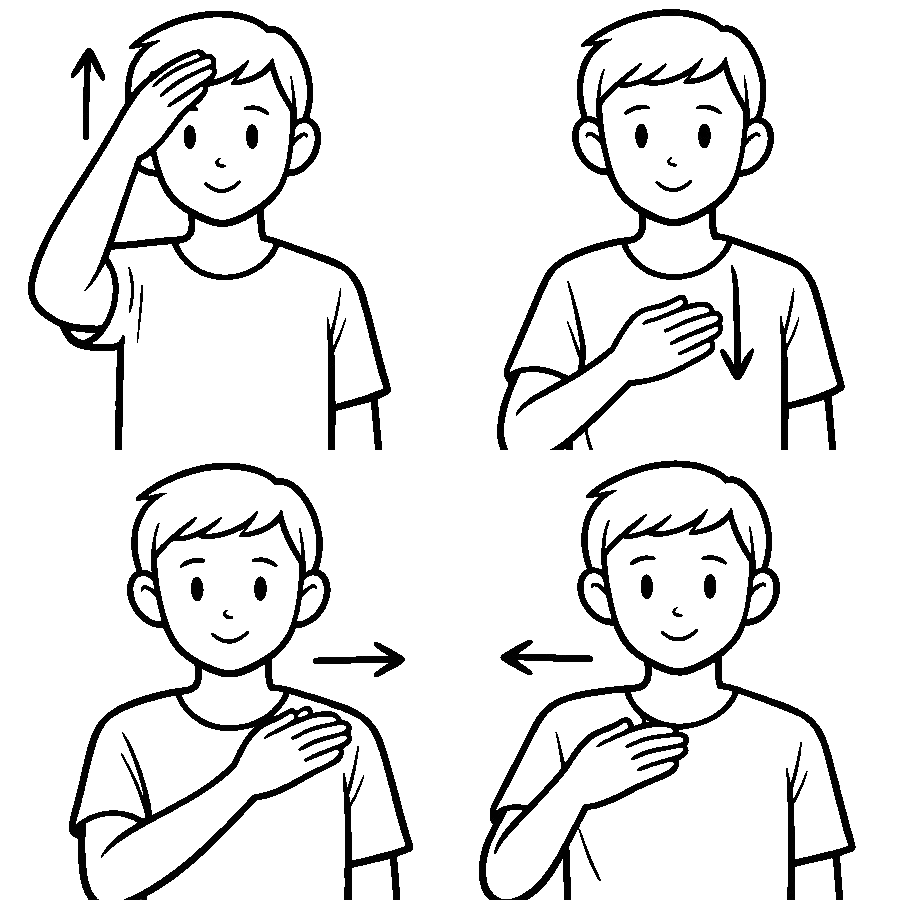
The goal is to make a shape of the Cross on your body. Using your right hand, touch your…
1. Forehead.
2. Chest.
3. Left shoulder.
4. Right shoulder.
Use your right hand if you can. If your right arm is injured, or you are left-handed and the other way comes more naturally, use the other hand—the prayer is the same either way.
If you want, you can also make this shape with your right hand…
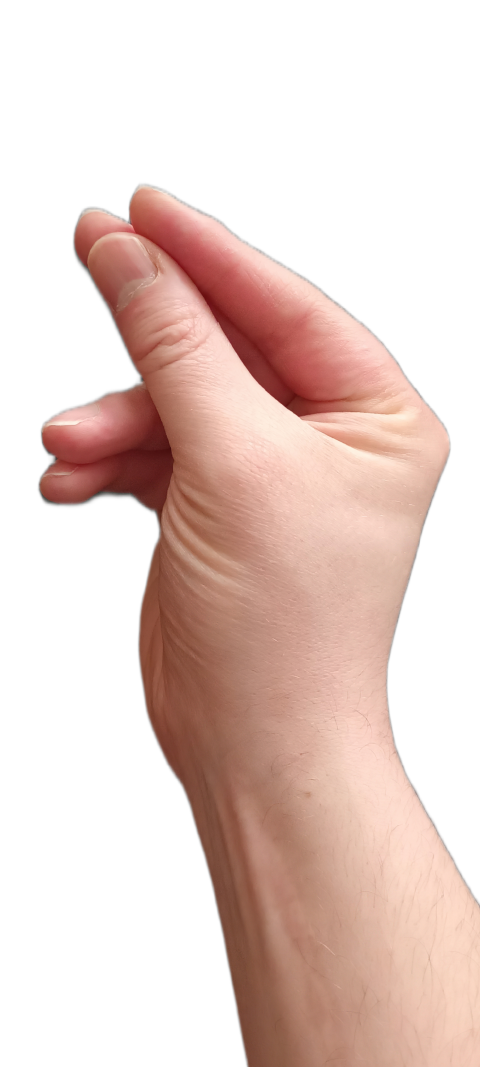
This is called the hand of Benediction and is seen in ancient Christian art. The two upright fingers, pressed together, represent how Jesus is both fully God and fully man, united together in His one person. The bottom three fingers represent the Trinity: Father, Son and Holy Spirit.[1]
It’s a traditional hand gesture for blessings. Although some scholars think it may originate from someone who had nerve damage in their hand! [2]
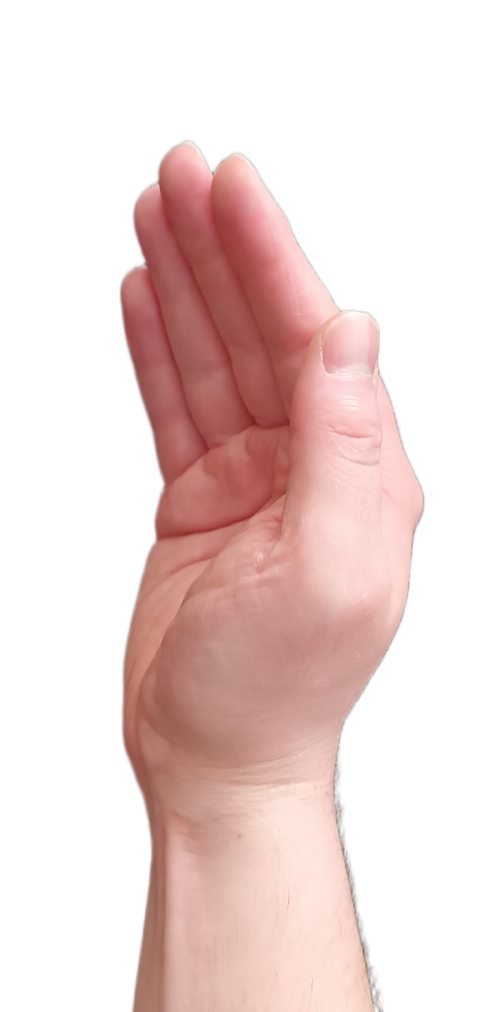
If you don’t want to do that, you can just make this gesture instead.
The Sign of the Cross Prayer #
The gesture itself is a prayer, but Catholics usually say these words while making it:
“In the name of the Father, and of the Son, and of the Holy Spirit. Amen.”
Those words are the end of Matthew’s Gospel, where Jesus sends the disciples out to baptise “in the name of the Father, and of the Son, and of the Holy Spirit” (Matthew 28:19).
You might also hear it in Latin: “In nomine Patris, et Filii, et Spiritus Sancti. Amen.” And in Spanish-speaking countries it’s traditional to add: “Por la señal de la santa cruz, de nuestros enemigos, líbranos, Señor, Dios nuestro”—“By the sign of the holy cross, deliver us from our enemies, O Lord our God.”
The Words in Latin, Spanish, French and Italian #
The same prayer is said in every Catholic country, so people often want to know what it sounds like in another language. Here it is in the ones most people ask about:
| Language | Words |
|---|---|
| English | In the name of the Father, and of the Son, and of the Holy Spirit. Amen. |
| Latin | In nomine Patris, et Filii, et Spiritus Sancti. Amen. |
| Spanish | En el nombre del Padre, y del Hijo, y del Espíritu Santo. Amén. |
| French | Au nom du Père, et du Fils, et du Saint-Esprit. Amen. |
| Italian | Nel nome del Padre, del Figlio e dello Spirito Santo. Amen. |
In Spanish you will also hear persignarse and santiguarse. They mean the same thing; which one people use depends on the country.
When Do Catholics Make the Sign of the Cross? #
Pretty much any time—it’s meant to be a quick prayer woven into ordinary life. But there are a few moments you’ll see it most:
- At the start and end of prayer. Most Catholic prayers begin and finish with it, including the Rosary.
- When entering a church. Often with a finger dipped in the holy water stoup, as a small reminder of baptism.
- When passing a church or cemetery. Many Catholics sign themselves as they go by.
- Before the Gospel reading at Mass. Catholics trace a small cross on their forehead, lips and chest, often saying quietly: “May the words of the Gospel be in my mind, on my lips and in my heart.”
- Before and after meals. A quick cross over the food, and over yourself.
- Over someone else. Parents often trace a small cross on their child’s forehead to bless them or say goodnight.
- At blessings, or whenever they feel in need of God’s protection.
Most Catholics learn it as small children, long before they could explain it.
The Great Sign and the Small Sign #
Catholics make the Cross in two sizes, and knowing the names helps when you are following along at Mass.
The great sign is the one described above: forehead, chest, then shoulder to shoulder, with the words said out loud or under your breath.
The small sign is a cross traced with the thumb on the forehead, lips and chest. You will see it just before the Gospel is read, and on Ash Wednesday when the ashes are put on your forehead.
Catholic and Orthodox: What’s the Difference? #
Both make the same prayer with the same words. The differences are in the hand and the direction.
- Direction. Catholics go from the left shoulder to the right. Orthodox Christians go from the right shoulder to the left.
- Fingers. Catholics usually use an open hand. Orthodox Christians join the thumb and the first two fingers and fold the last two into the palm—three fingers for the three Persons of the Trinity, two for the two natures of Christ.
- Everything else. The words, the meaning and the length are the same.
Some of the more traditional Protestant denominations (such as Lutherans and Anglicans—called Episcopalians in the US) also make the sign of the Cross, the same way Catholics do. You can read more about the differences between Catholics and other Christians.
Signing the Cross throughout History #
As you can probably tell, you can sign the Cross in different ways, and Christians have throughout history. The oldest surviving mention goes back to Tertullian in the early 3rd century.
“At every forward step and movement, at every going in and out, when we put on our clothes and shoes, when we bathe, when we sit at table, when we light the lamps, on couch, on seat, in all the ordinary actions of daily life, we trace upon the forehead the sign”. [3]
Note that the signing of the Cross was on the forehead. This goes back to Bible verses such as Ezekiel 9:4 and Revelation 7:3, 9:4 and 14:1, which describe God’s seal being on people’s foreheads. In Ezekiel, God tells an angel to put a mark on the foreheads of everyone who grieves over the sins of the city. The Hebrew word for that mark is taw, the last letter of the alphabet, and in the old script it was shaped like a cross. St. Jerome read the verse exactly that way.[4]
But Tertullian also tells us about a woman signing the Cross over her bed,[5] and in AD 404, St. Jerome tells us that Christians were signing the Cross on their mouth and chest too[6]—Catholics still do this for the Gospel reading at mass!
Right to Left #
By the 9th century in the East, the signing of the Cross was done over the body like this, with the hand of Benediction:
- Forehead.
- Chest.
- Right shoulder.
- Left shoulder.
This was in response to the Monophysite heresy, which taught that Jesus only had one nature. Catholics wanted to emphasise the two natures of Christ, and the hand of Benediction, signed over the body, clearly showed this.[5]
But notice that they signed the right shoulder first instead of the left. This seems to have been the original way of making the larger Cross sign that we’re used to today.
Left to Right #
Western Christians began to copy the East, but some started signing left to right instead.[5] There was diversity for a while. Pope Innocent III in the 12th century mentions the sign of the Cross over the body, but he doesn’t say which shoulder should come first.
By the end of the 14th century, Mirror of our Lady, written by the nuns of Syon Abbey in England, has an apparition of Mary teaching the sign of the Cross left to right.[5] We can only guess that left to right became common in the West from around here on out.
Today, left to right is how most Catholics sign the Cross, and it is the form described at the top of this page.
What Signing the Cross Means #
The Catechism puts it in one sentence:
“The sign of the cross, on the threshold of the celebration, marks with the imprint of Christ the one who is going to belong to him and signifies the grace of the redemption Christ won for us by his cross.”
Catechism of the Catholic Church [7]
It’s a reminder that we belong to Jesus Christ and how His death on the Cross means we can be forgiven and set free. The priest traces this same cross over every child at baptism, welcoming them into God’s family.
That is worth sitting with for a second. Every time you sign yourself, you are repeating something that was done to you before you could answer for yourself, and saying that you still want it.
Signing the Cross is a sacramental, which is a sacred sign that helps us receive and cooperate with God’s grace.[8]
Teaching a Child to Make the Sign of the Cross #
Children usually pick it up at about three or four, and they tend to enjoy it because it gives their hands something to do while they pray.
- Say the words slowly and let them copy one movement at a time.
- Guide their hand the first few times, then let go.
- Keep the words the same every time. The rhythm is most of the memory.
- Don’t correct the shoulder order at first. Getting the shape and the names right matters more than the direction.
Another Way to Pray #
Sometimes people treat the signing of the Cross like it’s a superstitious or strange thing, but really, it’s just another way to pray. The apostle Paul teaches Christians:
“Therefore, I urge you, brothers and sisters, in view of God’s mercy, to offer your bodies as a living sacrifice, holy and pleasing to God—this is your true and proper worship.”
Romans 12:1.
In my opinion, we don’t just communicate with God through words, or our mind—we’re supposed to use our body too. Signing the Cross is one way to do this.
It’s a powerful prayer. St. Augustine, in City of God tells about a woman who was healed of breast cancer after someone signed the Cross over her.[9]
So, whichever way you do it, and whatever type of Christian you are, why not start making the sign of the Cross?
Sources: #
1. Tristan, F., Buculei, E. and Boroş, A., 2002. Primele imagini creştine: de la simbol la icoană, secolele II-VI. Meridiane. ↑
2. Futterman, B., 2015. Analysis of the papal benediction sign: the ulnar neuropathy of St. Peter. Clinical Anatomy, 28(6), pp.696-701. ↑
3. Tertullian, late 2nd or early 3rd century. De Corona, chapter 3. ↑
4. St. Jerome, early 5th century. Commentary on Ezekiel, on 9:4. ↑
5. Ghezzi, B., 2004. The sign of the cross: Recovering the power of the ancient prayer. Loyola Press. ↑
6. St. Jerome, AD 404. Letter 108, paragraph 21. ↑
7. Catholic Church (1992). Catechism of the Catholic Church, 1235. Available at: https://www.vatican.va/content/catechism/en/part_two/section_two/chapter_one/article_1/iii_how_is_the_sacrament_of_baptism_celebrated.index.html. Accessed on: 16/11/26. ↑
8. Catholic Church (1992). Catechism of the Catholic Church, 1670. Available at: https://www.vatican.va/archive/ENG0015/__P58.HTM. Accessed on: 16/11/26. ↑
9. St. Augustine, early 5th century. City of God, Book 22, chapter 8. ↑