 Catholica

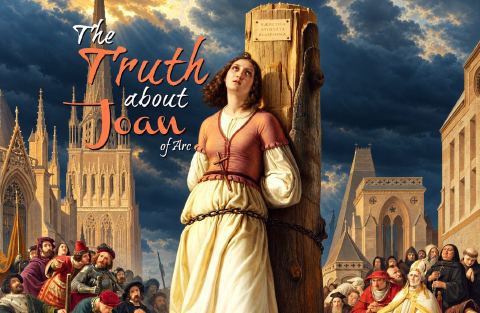
Some of you may already know that I run a little Facebook group dedicated to St. Joan of Arc. A few of you may even have heard the song I wrote about her (you’ll find it at the bottom of this page, so consider yourselves warned). So it probably won’t come as a shock to learn that, over the years, I’ve developed a bit of an obsession with the Maid of Orléans.
And yet, for all my reading, I’ve always found Joan hard to pin down, and so has everyone else. She was difficult to define in the 15th Century and she still is today. That makes it quite hard to work out what’s true about Joan of Arc and what isn’t.
Because here is the thing that has nagged at me for years: everybody claims Joan. The feminists claim her as their prototype. The nationalists claim her. Protestants have tried claiming her as a kind of proto-reformer. She’s been called a witch, a whore, a cross-dresser and a schizophrenic: everything, it seems, except what she actually was.
So a while back I decided to do something surprisingly few people bother to do. Instead of reading another modern biography (and goodness knows there are thousands of them, each spinning a different angle), I went back to the sources. In the early months of 1431, an illiterate nineteen-year-old girl sat in an English-held castle in Rouen and answered hundreds of questions put to her by some of the most learned churchmen in Europe, and the clerks wrote down her answers almost word for word. That document, the record of her Trial of Condemnation, still exists today.
And it is gripping.
Whether or not you end up as convinced as I am, I can promise you this much: the real Joan is far more interesting than any of the myths. Here is what I found.
1. Everybody Wants A Piece Of Joan #
First, a quick tour of the claimants, because the tug-of-war over Joan began almost the moment she died.
She was deeply loved by the French during her brief time with them, so much so that, after her death, a lookalike toured the country collecting accolades by pretending to be her, claiming she had escaped the flames. This money-grabbing deception was pulled off, it must be noted, with the help of Joan’s own surviving brothers. It appears families really do give birth to both sinners and saints!
The strangest claimant was a copy nobody could fake. Months after Joan’s death, the French captains took up a young shepherd called Guillaume le Berger, who claimed divine revelations of his own and showed wounds in his hands, feet and side after the fashion of St. Francis’s stigmata. The Burgundian chronicler Jean Lefèvre called the men who promoted him people of foolish credence
. The experiment ended at the skirmish chroniclers name the Battle of the Shepherd: the boy was captured, led bound like a thief
through Paris in nine-year-old King Henry’s triumphal entry, dismissed as a fool and, Lefèvre says, drowned in the Seine. Martial d’Auvergne’s verses put the point sadly: the poor lad had said he was sent by God for the love of the late Maid
, and every man wished to do like her
. Nobody ever managed it twice.
Conversely, and understandably, she was loathed by the English of her day, the ones who captured her, accused her of demonic possession and burnt her. Even 160 years later, Shakespeare portrayed her in Henry VI as a witch and a whore, in line with the insults English soldiers threw at her during the Siege of Orléans (the latter insult making her weep).
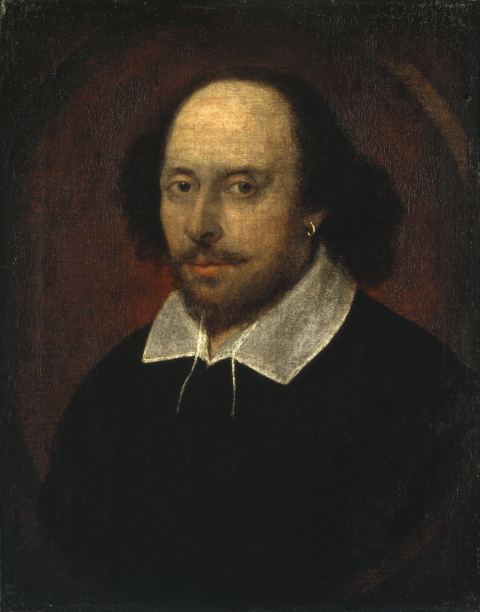
William Shakespeare (1564-1616). This portrait, dated 1610 and attributed to John Taylor, hangs in the National Portrait Gallery. Shakespeare wrote his historical play Henry VI
in 1591.
And yet long before Shakespeare, we see a speck of English decency in the honest observation of one anonymous English soldier who, upon hearing Joan’s torrid screams and repeated invocation of the name of Jesus as she died, lamented these terrible words: God forgive us: we have burned a saint.
Fast forward to our own time and the claims multiply. She has been called the first feminist, the first Protestant, even one of the first advocates of transgenderism, all because she wore male armour. In secular England she is superficially admired as a brave woman
, but the truth about Joan of Arc is rarely explored beyond that point. In fact, it is so unexplored that hundreds of people google was Joan of Arc real
every month!
And if that wasn’t confusing enough, there are other facets of Joan’s personality that do strike one as contradictory. She was, all at the same time, an illiterate peasant girl and an ennobled dignitary, the youngest ever commander and a girl more comfortable around soldiers than women at court, a perpetual virgin and a mystical visionary, meek and mild yet strong-willed and confident, often close to tears yet a relentless juggernaut against the English, uneducated yet a quick learner, an exemplary strategist untrained in theology, a menace to the Hussites, a great debater, an expert diplomat, a bastion of common sense, a miracle-worker, a teenager of unswerving supernatural faith and, to top it all off, an excellent sewer by her own account.
Small wonder the biographers keep trying.
2. The Most Documented Teenager In History #
Here is where it gets interesting for a modern reader, because we can actually let Joan speak for herself.
Between February and May of 1431, Joan was interrogated across a series of public sessions in the castle chapel and then, day after day, in her prison cell. Dozens of doctors of theology and law took turns questioning her, and the notaries wrote it all down. Every dodge, every deflection, every bold answer. The resulting record is so detailed that we know Joan of Arc better than almost anyone else in the entire Middle Ages.
Nor does the documentation end there. Twenty-five years after her death, the Church opened a second trial, the Trial of Rehabilitation, and tracked down everyone still living who had known her: her childhood friends, her comrades in arms, the priests who had examined her, even officials who had sat in on her condemnation. Their sworn memories of her are every bit as striking as her own answers.
So when people ask was Joan of Arc real?
, the honest answer is that she’s one of the best-attested human beings of the medieval world. The question isn’t whether we know her. It’s whether we like what the record actually says.
And the record does not stop with the trials. Joan marched through a Europe crawling with chroniclers, and they wrote her down as she went: Perceval de Cagny riding beside her favourite commander, the Duke of Alençon; the Burgundian Monstrelet standing in the camp that captured her; a German courtier, a Scottish abbot, even a pope. Thirteen of her own dictated letters survive too, and while she was still alive, poets were already turning her into verse. So we can watch Joan through other people’s eyes as well as her own, and that is where the picture gets really vivid.
3. The King Who Was About To Give Up #
Before we get to her trial, you need to see what Joan walked into at Chinon, because the chronicles make clear it was not a heroic court-in-waiting. It was a sinking ship.
Pope Pius II, who collected eyewitness accounts at the Council of Basel a few years later, records that when Joan set out, Charles VII was not planning a comeback. He was planning an abdication. He had resolved to write to the King of Castile offering him the crown of France in exchange for some corner of land wherein he might lurk in safety.
The heir of France was shopping for a hiding place when an eighteen-year-old peasant girl arrived to tell him to fight.
And he was broke. The Dean of Saint-Thibaud records that Charles was so poor a shoemaker in Bourges once refused him credit for a pair of boots, and took back the one he had already put on. Paris and Reims were in enemy hands, and Orléans was in its seventh month of siege.
She won her escort to that audience with a prediction nobody could explain away. On the day the French army was cut to pieces at the Battle of the Herrings, over a hundred miles away and before any courier could possibly have arrived, the Journal of the Siege records that Joan told Robert de Baudricourt, the sceptical captain of Vaucouleurs, that the king had had great damage before Orléans, and would have still more, if she were not led to him.
Baudricourt, who the chronicler says had already proved her and found her very wise and as it were truthful
, finally gave in. He had her dressed in man’s clothing and gave her an escort. Her first miracle was not worked on a battlefield. It was persuading a hard-headed border captain to stake his reputation on a shepherdess.
So the celebrated first audience was a last throw of the dice, and Charles played it like a man who trusted nobody. He stayed in the crowd while more splendidly dressed lords stood about him, and when Joan addressed him he answered: It is not I who am King, Joan,
pointing at one of them: There is the King.
The chronicler Jean Chartier records her reply: In God’s name, gentle prince, it is you and no other.
And as the questioning went on, the clerks and captains marvelled at the girl who answered as knowingly about war as about the things of God.
Whatever else she told him stayed behind sworn lips. Before a handful of witnesses bound to silence, the Chronique de la Pucelle records, she told the king of something he had done right secretly
, at which he was much astonished, for there was nobody who could know it but God and he.
To this day nobody knows what she said. Her confessor Brother Pasquerel would offer only that the king and the Duke of Alençon knew certain secrets which they could declare if they willed.
Neither ever did.
Then the French did something the English never did: they checked. For six weeks, the German courtier Eberhard de Windecken records, she was examined at Poitiers by old, experienced folk, by the learned, clergy and lay, by women and men, openly and secretly.
The conclusion reported back to the king: no evil was found in the aforenamed maid, but all goodness: humility, maidenhood, spirituality, honesty, sobriety.
And when Charles asked for a sign to prove she came from God, she told him she would give it at Orléans, and not sooner, because God had so ordained it.
The examiners went in scoffing and came out converted. Before they heard her, the Chronique de la Pucelle says, the learned men of Poitiers dismissed the whole business as ravings and fancies
; afterwards there was none of them who did not say that she was a creature of God; and some of them, in returning, wept hot tears.
Brother Séguin, the Dean of Poitiers’ theology faculty who interrogated her and lived to testify at her rehabilitation, asked her what tongue her voice spoke. A better tongue than yours,
she told the Limousin professor. And when a Jacobin doctor objected that if God willed the English gone, arms were unnecessary, she gave the answer that should be printed on every pacifist’s wall: she wished only a few men who would fight, and God would give the victory.
Windecken also preserves the conditions she set the king before she lifted a finger: that he should give his kingdom back to God who lent it to him; that he should pardon everyone who had fought against him; and that he should humble himself so that anyone, rich or poor, friend or enemy, could come to him for grace. The illiterate teenager was not asking a king for a job. She was telling a king how to be one.
4. Her Trial Was Rigged From The Start #
Now, I have to be honest about what I found in that record, because this is the part that reads less like history and more like a thriller.
The judge, Pierre Cauchon, Bishop of Beauvais, was a counsellor to the King of England, and English Privy Council records show that his compliance was bought with the promise of the then-vacant archbishopric of Rouen. The man judging Joan literally had a promotion riding on her conviction.
Her confidant
was a plant. A canon named Nicolas Loyseleur was placed in her cell, posing as a prisoner loyal to the French party and claiming to be from Joan’s own province of Lorraine. He gained her trust by talking about the king and his own supposed revelations, and he promised Joan she would be saved. All the while, he secretly reported everything she said back to the bishop, including what she told him in confession, which is a serious breach of Catholic canon law. Legend has it that on the day of her execution he was so distraught over his sin that he begged forgiveness at Joan’s feet. However, the historical record of his later actions puts this story in serious doubt.
It gets worse. The notary Guillaume Manchon testified that at the start of the trial he was stationed with a colleague in a neighbouring chamber where there was a hole through which one could listen
, so that whatever Joan confided to Loyseleur, even in confession, could be written down and turned into interrogatories to catch her craftily
. And when Manchon went on faithfully writing down her answers, excuses and all, the judges tried dictating a different Latin wording to him, while two concealed scribes behind a curtain produced a parallel record with her defences simply left out. Where the manuscript margin still reads Nota
, Manchon said, that is where the fight happened, and where she had to be interrogated all over again because what he had written was true.
Her prison was not a Church prison at all. She was kept in an English military castle, in iron chains and fetters, guarded night and day by unscrupulous English soldiers. These are conditions she repeatedly complained about, and they explain her insistence on protective male clothing better than any ideology can.
For her first weeks in Rouen they kept her in something worse than a cell: a smith named Étienne Castille built her an iron cage, and she was held in it upright, bound by the neck, hands and feet
, until the process began.
When the one sympathetic examiner, Master Jean de La Fontaine, tried to enlighten her on points of law, Cauchon threatened him. After March 27 he simply disappears from the sessions. Master Jean Lohier, a respected Norman lawyer brought in to review the case, declared the whole trial worthless: it had no proper form, the court sat behind closed doors, the King of France’s party was never summoned, and a simple girl
faced a room full of masters and doctors with no counsel. Cauchon stormed to the assembled masters that Lohier would call everything in question
, and Lohier wisely left Rouen. And when sympathetic churchmen pointed out that the Council of Basel was then sitting, with clergy of Joan’s own obedience present, and suggested she submit to it, the bishop shouted Be silent in the name of the devil!
The men who suggested it were expelled from the city under pain of death.
And they used the sacraments as leverage. Joan begged to hear Mass, but the judges made her an offer: abandon your male clothing first. Her counter-offer is so very Joan that it deserves quoting: she asked them to have a long garment made for me, reaching to the ground, without a train, and give it to me to go to Mass; and afterwards, on my return, I will resume the clothing I have.
Finally, on May 9, they brought her into the great tower of the castle and showed her the instruments of torture, prepared and ready. A nineteen-year-old girl stood before them and said this:
Truly, if you should make me have my limbs torn apart, and make my soul depart from my body, I would not say anything else to you; and if I should say anything of this to you, afterward I would always say that you had made me say it by force.
Three days later the judges assembled and concluded that torture, in her case, would profit little
. Read that again. The entire apparatus of the English occupation and the University of Paris blinked first.
And the fix went all the way to the purse-strings, because the accountants kept receipts. The English crown’s own ledgers record Cauchon being paid for 153 days of work on the business of Joan who is called the Maid
, including journeys to the Duke of Burgundy and to Jean de Luxembourg to negotiate her purchase, all before the trial had even opened. The same ledgers show the doctors of the University of Paris who pronounced her a heretic each drawing twenty sous tournois a day for attending her trial. The men who judged her were literally on the payroll of the regime that had bought her: Luxembourg had just sold his prisoner to the English for some ten thousand gold pieces, a king’s ransom for a teenage girl. The Estates of occupied Normandy were made to vote a war tax that the surviving assessments describe as levied for the purchase of the Maid and the continuation of the war
, and the treasurer of Normandy was ordered to buy 2,636 gold nobles in English money to settle the bill. Joan of Arc was acquired the way you buy cargo: by invoice.
5. The Answers That Stopped Me In My Tracks #
This is my favourite section, because Joan on the page is funny, sharp and utterly fearless: sometimes all three in one answer.
Asked the classic trap question (do you know that you are in the grace of God?) she was caught between two fatal answers. Say yes and she’d be condemned as presumptuous; say no and she’d be admitting she was a sinner abandoned by God. Here’s what an illiterate teenager said to a room full of the finest theological minds in Europe:
If I am not, may God place me there; and if I am, may God keep me in it. I should be the most sorrowful in all the world, if I knew myself not to be in the grace of God.
The notaries wrote it down, and over 550 years later, so did the writers of The 1992 Catechism of the Catholic Church. They must have known they were witnessing something remarkable, because the trap never worked again.
Asked whether St. Margaret spoke English, she replied: How should she speak English, since she is not of the party of the English?
Asked whether St. Michael was naked, she answered with the brisk theology of a farm girl: Do you think that God has not wherewithal to clothe him?
And whether he had hair: Why should it have been cut off?
When Brother Richard approached her at Troyes nervously making the sign of the cross and sprinkling holy water (testing whether she’d react like a demon) she told him: Approach boldly, I will not fly away.
The friar paid for his association with her in the end: in March 1431, while Joan sat in her cell at Rouen, the vicars of the bishop of Poitiers and the inquisitor had the Parlement there order the popular preacher to stop preaching and to remain under arrest in his Franciscan convent. The register does not say what he had been saying. It is hard not to wonder whether he was preaching too warmly about the prisoner her king had abandoned.
Pressed to swear the same oath for a second time, she pushed back like any teenager would: I made the oath to you yesterday; it ought well to suffice you. You burden me too much.
And then, in a line that reads almost like prophecy, she warned the very bishop who would have her burned: Take good heed of this, that you say you are my judge, because you assume a great burden.
Asked which she preferred, her banner or her famous sword, she answered that she preferred the banner forty times
more, and the reason gives the lie to the whole bloodthirsty warmonger
caricature: she said she carried the banner herself when attacking for avoiding lest she should kill anyone; and she says that she never killed a man.
And asked why that banner had been carried into the church at Reims for the coronation ahead of every captain’s banner, she gave an answer that still catches in the throat: it had been in pain: it was well reasonable that it should have honour.
And on the one secret they truly wanted, the private sign she had given her king, the thing that convinced Charles VII to trust her, she stonewalled for weeks: I always answered you that you will not extract that from my mouth. Go to ask him.
She had sworn to St. Catherine never to speak of it, she said, because men pressed me too much to speak.
Pressed past the point of refusal, in the March prison sessions she finally gave them an answer so grand it sounds like a parable: an angel had brought the king a crown of fine gold, which no goldsmith in the world could have made so rich; it lay in the royal treasury, she said, and would endure a thousand years and more.
Memory, metaphor, or a teenager spinning a tale for her tormentors? Either way she could not resist the last word. Asked whether the sign was gold, silver or precious stone, she answered: I will not tell you; nor could any man describe a thing so rich as the sign; and yet the sign that you need is that God deliver me from your hands, and it is the most certain that He can send you.
It seems Charles took his own share of that secret to the grave; years on, historians still debate what it could have been.
6. The Bits I Had To Read Twice #
Then there are the passages where I genuinely had to stop and re-read, because they sound like legend but sit right there in the sworn record.
Her sword was found by miracle. She told the judges that her voices had revealed a sword buried in the ground behind the altar of the church of St. Catherine of Fierbois, marked with five crosses and thick with rust. She sent a man she’d never seen to fetch it; the churchmen found it exactly where she said, and when they rubbed it, the rust fell away immediately.
She predicted her own wound. At the assault on the bastille of the Bridge at Orléans, Joan was the first to set a ladder against the walls, and took an arrow (or crossbow bolt) in the neck. The record states she had foretold this to the king before it happened. She was healed within fifteen days and back at work.
She predicted her own capture, too, and the date. Weeks before Compiègne, she told the court, Saints Catherine and Margaret had warned her at Melun that she would be taken before the feast of Saint John
, and repeated the warning many times, and almost daily.
She begged them for one mercy: that when she was captured she would die at once, without long vexation of prison
. The voices answered only that she must accept everything gladly, and that it had to happen so.
Asked whether she would still have ridden out that day had she known the hour, she gave the honest answer: no, she would not have gone willingly, but nevertheless, she would have obeyed the command of those voices, whatever might have happened to her.
She rode out. She was taken.
She prophesied the liberation of France on a deadline. In March 1431 she told her judges: Before seven years are passed, the English will lose all in France, and this will be by a great victory which God will send to the French.
And she added, with typical zealous impatience, I should be well angry that it were so much deferred.
Paris returned to French hands in April 1436, five years after a condemned prisoner said it would.
She survived a jump that should have killed her. Imprisoned in the tower of Beaurevoir after her capture, hearing that Compiègne was to be put to fire and sword and that she’d been sold to the English, she jumped, commending herself to God on the way down. She couldn’t eat for days afterwards, until, she said, St. Catherine told her to confess and ask God’s forgiveness for the jump, and promised that Compiègne would be relieved before winter. It was.
She even had to account for a miracle. At Lagny, she told the court, a baby three days old was carried before the image of Our Lady in the church; it was said no life had appeared in him for three days, and he was as black as her own tunic. The town’s girls were praying for him, so she went and knelt on her knees and prayed with them, and at last life appeared in the child, who gasped three times, was baptised, and immediately afterwards died, to be buried in consecrated ground. Her judges wrote that one down too.
And she debunked a rival prophetess with the cheerful scepticism of a born detective. Catherine de La Rochelle claimed a white lady
clothed in cloth of gold came to her every night, promising to sniff out hidden treasure that could pay Joan’s men-at-arms. Joan’s response is the most sensible in the whole record: she asked to share Catherine’s bed so she could see the apparition for herself. She watched until midnight and saw nothing. Catherine swore the lady had come while Joan slept. So Joan slept through the next day in order to keep watch the entire following night, lay beside the prophetess till dawn, and saw nothing again, though Catherine kept promising Yes, immediately.
Her verdict, delivered to Catherine’s face, was that she should go back to her husband, keep house and raise her children. Her own saints, she told the judges, had told her the whole business was nothing but foolishness.
The prophetess’s champion, Brother Richard, never forgave her for it.
And here is the strangest entry in the file, because it is not about Joan at all: it is about her father. She told the judges that her father had dreamed, again and again, that his daughter would go off with men-at-arms, and was so tormented by it that he told her brothers: If I thought that what I dreamed of her would happen, I would want you to drown her; and if you did not do it, I would drown her myself.
She obeyed her parents in everything, she said, except that one departure. Asked whether leaving them was a sin, she answered that since God commanded it, if she had a hundred fathers and mothers, and she were the daughter of a king, she would nevertheless have departed.
Afterwards she wrote to them, and they forgave her.
7. What Her Friends Swore To #
The Trial of Rehabilitation is where Joan’s story gets its colour back, because the people who actually knew her finally got to speak under oath, twenty-five years on.
Her childhood friends from Domrémy remembered a girl so ordinary she was almost boring: she sewed, she span, she minded the animals, she went to church so often that the other girls teased her about it. One friend of Joan recalled that she was an excellent Catholic, and a modest woman: she communicated often, and, at sight of the Body of Christ, shed many tears. In all she did, except in affairs of war, she was a very simple young girl.
The first soldier to take her seriously was Jean de Metz of Vaucouleurs, and he swore to what the girl in the poor red dress told him when he asked whether the king must really be driven out and England rule: Before it be mid-Lent, it behoves me to be towards the King, though I should lose my feet up to the knees. For none in the world, neither kings nor dukes nor the daughter of the King of Scotland, can recover the realm of France, nor is there succour for him save from myself.
Asked who her Lord was, she answered: God. Metz put on his armour and rode beside her all the way to Chinon.
When she first arrived at Chinon, one eyewitness described a poor little shepherdess
presenting herself before the king with great lowliness, saying simply: Most noble Lord Dauphin, I am come and am sent to you from God to give succour to the kingdom and to you.
The king made her wait two days before he would even see her.
Dunois, the Bastard of Orléans, the commander whose city she saved, swore that her behaviour in war was a fact divine rather than human
. He was there on the Loire when the convoy was stranded, the wind dead against them, and Joan told him: I bring you better succour than has ever come to any general or town whatsoever: the succour of the King of Heaven.
The wind, Dunois testified, then turned all at once and became favourable, and the boats sailed straight to Orléans.
Dunois also swore to something quieter. Every day at vespers, he said, she slipped into a church, had the bells rung for half an hour, gathered the mendicant friars who followed the army, and prayed while they chanted an antiphon to Our Lady. And once, riding beside him through crowds roaring Noël!
as the king entered Crépy, she said: Behold a good people; never saw I any other people who rejoiced so much at the coming of so noble a king. And would that I were so happy, when I shall end my days, that I might be buried in this land!
Asked where she hoped to die, she answered: Where it shall please God.
She wished, she added, only to lay down arms and go home to keep her parents’ sheep with her brothers and sister.
Though even that touching wish has a wrinkle in the paperwork. The contract registers of Orléans cathedral preserve the record of a house in the city that Joan had leased from the cathedral chapter, with a man named Guillot de Guienne standing surety for her while she campaigned. Nine months after her death the surety re-let the lease, and it still had fifty-nine years left to run. Whenever Joan pictured the war finished, it seems she pictured herself settled not among the flocks of Domrémy but in the city she had saved, among a population, as one historian put it, where she counted only friends.
And Jean d’Aulon, the veteran knight the king appointed to guard her, gave the testimony that answers the crazy girl playing soldier
claim better than anything else. Travelling, sleeping and fighting alongside her for a year, he swore he had never known a more sober or more chaste woman: Neither I nor others, when we were with her, had ever an evil thought: there was in her something divine.
D’Aulon also told the story no novelist would dare invent. Joan spoke of her heavenly counsel
as three: one who stayed with her always, one who came and went, and a third with whom the other two deliberated. D’Aulon once begged to be shown them. She told him he was not worthy or virtuous enough to see them
, and he never asked again.
Her chaplain Brother Pasquerel, who never left her side from Blois to Compiègne, swore to the details the generals missed. She confessed nearly every day. When food ran short on campaign she would sooner go hungry than touch stolen victuals. She wept over wounded Englishmen and had them confessed before they died. And she told Pasquerel that if she herself were killed, the king should found chapels to pray for the souls of the men who had died in the war.
Joan described her heavenly Counsel to the court like this: when people wouldn’t believe her, she said, I retire alone, and pray to God… and, my prayer ended, I hear a Voice which says to me: ‘Daughter of God! go on! go on! go on! I will be thy Help: go on!’
8. By My Staff #
Now for the part I enjoyed most in the chronicles, because the eyewitnesses did not just record Joan’s words. They recorded her weeks.
Her oath, incidentally, was not by God
or by heaven
. The Duke of Alençon’s own chronicler, Perceval de Cagny, tells us she swore by my staff
, a homely little oath she had taught the veteran soldier La Hire to use in place of God’s name.
At Orléans, the English condemned to the flames the very herald who had brought them her summons to leave France, and built the stake to burn him on. When they fled days later, they left him behind in irons. And William Glasdale, the captain who shouted filth at her across the siege lines, got a personal prophecy: she told him he would die before the English departed, and would never see them go. Days later the bridge of the Tourelles broke under him and he drowned in full armour in the Loire. And she was no adrenaline junkie: d’Aulon swore that never had she seen the blood of a Frenchman that her hair did not rise upon her.
She was shot through at that same assault, and the record says she had predicted the wound to the king beforehand. Windecken, writing from the official reports, tells us what she did next: she had a little olive oil put on it, went aside, knelt and called on the heavenly Father, then climbed back into the ditch and told her men the English had no more power. The Journal of the Siege, the contemporary Orléans diary, preserves the most quoted scene of the whole siege. She left her standard, rode a little apart to pray, and told a gentleman standing near to keep watch for the moment the tail of her standard touched the English fortification. A few minutes later he cried: Joan, the tail touches!
Her answer: All is yours, and in you go!
The assault was renewed and the fort fell. The English prisoners marched inside the city that evening swore to something stranger still: that while the French attacked, it had seemed to them that the whole world was assembled against them. And the next morning, when the beaten English drew up in battle order to cover their retreat, she forbade the French to attack for the love and honour of the holy Sunday
, so long as the English did not assail them. The English took the hint and marched away. Joan had won Orléans without a battle on the last day of the siege.
Six weeks later at Patay, the scouts could not find the English army at all, until a stag burst from cover and plunged through their hidden line, drawing the cry that gave them away. Asked where the enemy was to be found, Joan answered: Ride hardily, we shall have good conduct.
It was a rout: thousands of English dead, the great Lord Talbot a prisoner, and Sir John Fastolf running so fast he was stripped of the Order of the Garter for cowardice. His peers later gave it back, but the stain stuck. At Jargeau days before, the captured Earl of Suffolk had refused to surrender to an unknown squire until he had knighted the man himself, so that history would record he had yielded to a knight. Alençon swore that during the Jargeau assault Joan pulled him from the spot where he stood, pointing to an engine in the town: that machine will slay thee.
Alençon moved; a few moments later the engine’s stone killed the lord du Lude on the very spot he had just left.
Not everyone who fought beside her believed in her, and the best account of a sceptic’s conversion comes from the sceptic’s own man. Arthur of Richemont, the exiled Constable of France, turned up at the siege of Beaugency with a private army the king had expressly forbidden him to bring. Joan and Alençon rode out to meet him; and Guillaume Gruel, the Constable’s own chronicler, records that she dismounted and threw her arms around his knees in greeting. The grizzled Breton warlord looked down at her and delivered the verdict of a man hedging every bet at once: Joan, I am told you mean to fight me. I know not whether you are of God or no. If you are of God, I fear you not at all, for God knows my good will. If you are of the devil, I fear you even less.
They joined forces, and Beaugency surrendered the next morning. When Talbot, Scales and Fastolf, marching to relieve it, heard that the Constable had arrived, they abandoned the attempt — which is how the road to Patay was left open.
The march on Reims nearly died at Troyes. The army had run out of bread, the council had voted to turn back, and it was the old counsellor Robert Le Maçon who said: send for the Maid. Joan rode in, asked the king twice whether he would believe what she told him, then declared: Gentle King of France, if you will remain here before your city of Troyes, it will be in your obedience within two days, whether by force or by love.
Then she rode along the ranks with a staff in her hand, directing the gathering of doors, tables and shutters for siege works. Troyes opened its gates the next day, and when the garrison marched out under safe-conduct with their French prisoners, she made them give the prisoners up.
And Reims was never just ceremony. The French believed no man was truly King of France until he was anointed with the holy oil kept there, sent down from heaven, they said, by a white dove to St. Remigius. Pius II records that the English had often discussed moving the oil out of the city but were, he says, hindered by divine will
. Reims opened its gates; the English garrison marched out one gate as Charles rode in another; and Joan stood in the cathedral holding her banner quite near the altar
while he was crowned. In less than three months she had put a king on his throne, and men, Perceval says, served her for the hope that she came from God, more than for wages
: Pius II puts the volunteers at thirty thousand horsemen who came at their own expense.
It was not all glory, and the chroniclers do not pretend otherwise. On that same march she fell on two or three camp-follower women with the flat of the miraculous Fierbois sword and broke it; the king scolded her that she should have used a good stick instead of a sword that had come from God. At Paris in September she took a crossbow bolt through the thigh, lay in the moat until dark and had to be dragged out against her will, crying: By my staff, the place would have been taken.
She was in the saddle at dawn demanding to attack again, but while she argued, the king had Alençon’s new bridge across the Seine secretly demolished in the night so she could not cross. When he then turned the army south, Joan left her whole harness, every piece of her armour, before the image of Our Lady at the abbey of Saint-Denis.
After that, the court fenced her in. Alençon, says Perceval, was never allowed to campaign with her again; the lord of La Trémoille, who governed the king, saw to that. Fed up with a council that preferred truces to victories, she finally slipped away without even taking leave of the king and went to fight the raiders around Lagny. Even out of favour she was lethal: at Saint-Pierre-le-Moûtier, when the assault broke and the French fell back, d’Aulon, himself shot through the heel, watched her ride back almost alone, crying to the stragglers To the faggots and the hurdles every man, to make the bridge!
The town was stormed straightway. At Compiègne on 23 May 1430, she was in the rearguard covering her men’s retreat when the town’s own captain raised the bridge and shut the gate in her face, and she was dragged from her horse by a Burgundian archer. To the hands grabbing at her she gave the only answer that mattered to her: I have sworn and given my faith to another than you, and to him I will keep my oath.
One French chronicle adds a scene I want to believe. That morning at Compiègne, after confessing and hearing Mass at Saint-Jacques, she leaned on a pillar and told the hundred or so little children gathered to gawp at her: My children and dear friends, I signify to you that I have been sold and betrayed, and that shortly I shall be delivered to death. So I supplicate you to pray God for me.
And the same chronicle could not resist the coda: the captain who shut that gate, Guillaume de Flavy, was never punished by any man, so God arranged that Flavy’s own wife had him strangled in his bed by her barber, and then received the king’s pardon.
9. In Her Own Letters #
We also have Joan’s own letters. Thirteen of them survive, dictated to scribes but very much hers in tone: blunt, confident and shot through with the same voice you hear in the trial.
The first was sent to the English commanders besieging Orléans, written before she’d lifted a finger in battle. A teenager, writing to the most feared army in Europe:
Hand over to the Maiden, who is sent here by God the King of Heaven, the keys to all the towns which you have taken and violated in France… I am sent here by God the King of Heaven to drive you entirely out of France.
She warned them that she would raise a mighty outcry as has not been heard in France in a thousand years
. A few weeks later she had done precisely that.
When the English predictably ignored her letters, she had the next one tied to a shaft and shot into their camp by a crossbowman. That is the detail I love most: most people who ignore an email just get a follow-up, Joan sent hers by arrow.
And she had a secret code. She often wrote the names Jhesus Maria
with a cross on her letters, but sometimes, she told the court, she placed the cross in sign that he of her party to whom she wrote, should not do that which she wrote to him.
A teenage girl running a cipher under everyone’s noses.
She could be gloriously matter-of-fact about the impossible too. Her letter to the loyal French town of Tournai reads like a war bulletin from a commander three times her age: in eight days she has chased the English out of all the places they held upon the river Loire, by assault or otherwise.
And on the very day Charles was crowned at Reims, the busiest day of her life, she found time to write to the Duke of Burgundy begging him to make peace, with an extraordinary alternative if he insisted on fighting someone: if it please you to make war, then go upon the Saracens.
At the summit of her triumph, her instinct was to point an enemy army at a worthier target.
Her letters to the citizens of Reims are my favourites, because they show Joan the protector rather than the warlord. Hearing they feared a siege, she wrote: I promise and certify you that I shall not abandon you so long as I live,
and told them to send word of any traitors in their midst, and as soon as I can, I shall remove them from among you.
On the truce Charles had just signed with Burgundy she was blunt: I am not content, and I know not if I shall keep them.
And to any enemy thinking of marching on the city she promised to make them wear out their spurs so hastily that they shall not know where to take them.
We even know what she looked like mid-campaign, because two young noblemen, Guy and André de Laval, wrote home describing the day they met her: armed all in white save the head, a little axe in her hand,
on a great black courser that would not stand still for her to mount until she ordered it led to the wayside cross. Then, in a right woman’s voice,
she called to the priests to make processions and prayers to God, and rode off saying Forward, forward.
The brothers’ verdict, written to their own mother and grandmother: it seems a thing altogether divine, her deeds, and to see her and to hear her.
And one last letter, to the town of Riom, asks for powders, saltpetre, sulphur; shot, strong crossbows and other implements of war
for the siege of La Charité. It is signed JEHANNE
in a cramped, uncertain hand, the letters guided for her, because Joan could not write. The original still exists; a single hair and the mark of a finger are still pressed into the broken wax seal. Her signature was hers, but someone held her hand to make it.
10. What The Rest Of The World Wrote #
But perhaps the most striking material in these volumes is what other people wrote about Joan while it was all still happening, from every side of the war and beyond.
Start with her enemies. Enguerrand de Monstrelet was a Burgundian chronicler writing for the very faction that captured her, and he was at Compiègne. He records that when Joan was taken, the Burgundians and English rejoiced more than if they had taken five hundred fighting men: for they dreaded and feared no captain or other chief of war so much as they had ever done the said Maid.
Her enemies rated her the most dangerous commander in France.
And you can see that fear in their paperwork. The English crown’s own writs survive, ordering sheriffs across England to hunt down captains and soldiers who had deserted rather than cross the Channel. The official rubrics on those writs explain why the men ran: they were terrified by the enchantments of the Maid,
and the terrors of the Maid had driven them out of their wits.
Henry VI’s government was reduced to begging its own army to come to France.
And the Duke of Burgundy announced her capture to Henry VI himself, in a letter written from the field that same evening, naming himself the instrument of divine providence in her downfall: with them came she that thei calle the Pucelle… and God yaf me such grace, that she that thei calle the Pucelle was taken.
The London civic chronicles recorded the event with a compliment they could not quite bury in the abuse: she was a fals wyche,
they wrote, yet the French helden here amonges them as for a prophetesse and a worthy goddesse,
for she had never
had the worsse in place that sche hadde ben inne.
A false witch who had never been beaten: even the enemy’s annals could not make the two halves of that sentence fit. A monk at St Albans, entering the news in his annals for 1430, could only note that a girl called Le Puselle de Francia
had been taken in the deceitful crowd of the French.
The hostile diarist known as the Bourgeois of Paris, who loathed her, still records the rumour going round the capital: that as a little girl minding the sheep, the birds of the woods and fields came at her call to eat bread in her lap. He marks it apocryphal himself. Even her enemies could not resist repeating the legends.
Then there are the foreigners who watched from a safe distance. Walter Bower, a Scottish abbot writing his national chronicle from eyewitness reports, was fascinated by the little ring she wore on her left hand and gazed at continually, the very detail her prosecutors would twist into evidence of sorcery. Bower even found her foretold in Merlin’s prophecies — Behold, wars resound; a maiden bears the banners
— and signed off with the most beautifully hedged verdict in the whole corpus: she had done much good for the realm of France and struck terror into the English, he concedes, but by what spirit she presumed these things, He knows who knows all.
Pope Pius II gave her a sober chapter of his history a generation later, declining to rule whether it was a divine work or a human device
but confirming every fact; he even reports the cynical theory of his day, that some clever nobleman invented her as God’s messenger, on the grounds that there is no man who refuses God as leader.
And St. Antonino of Florence, a canonised saint like Joan herself, weighed her deeds and found in her nothing dishonest… nothing superstitious, in nothing deviating from the truth of the faith.
Another Scot went further than Bower ever dared: the compiler of the Liber Pluscardensis introduces his account of a certain marvellous maiden, Joan
by claiming he had seen her, known her, and remained in her company until the end of her life, a Scot, if his word is to be taken, in French service to the last. And a Venetian merchant at Bruges, Pancrazio Giustinian, writing home just weeks after the coronation, set down her programme as the French court understood it: raise the siege of Orléans, crown the king, make peace between him and the English, and free the Duke of Orléans from his English prison, or, if the English would not give him up, she would cross into England and take him in spite of them.
Whatever else Joan was planning, it did not stop at the Channel.
Her fame outran her armies. In 1429 the town accounts of Ratisbon, while the Emperor Sigismund was lodged there, record a payment of twenty-four pfennigs to view a picture showing how the Maid fought in France
: a blockbuster portrait of a teenage girl, exhibited in a country she never saw, while she was still fighting. That summer a letter from German agents reported that the Flemings and Picards would by no means leave their own country to help the English, and that much chivalry sets out from these German lands; they wish to go find the Dauphin at Reims
: knights were riding west just to see her. A Paris student named Jean de Vaulx wrote her deeds on the flyleaves of his own copy of Terence, he said, since it was a marvel
. And when the Burgundian envoy Bertrandon de La Broquière reached Constantinople in 1433, the Greeks asked him whether it could possibly be true that the Duke of Burgundy had taken the Maid, for it seemed to the Greeks a thing impossible
. News of Joan had reached the end of the known world.
But the most beautiful testimony of all comes from a woman. Christine de Pisan, often called the first professional female writer in Europe, was sixty-seven and had spent eleven years cloistered in an abbey since the Burgundian revolution drove her from Paris. In July 1429, while Joan was still alive and still winning, Christine broke her silence to write the last poem of her life, the only French verses about Joan composed in her lifetime that survive. They begin like this:
I, Christine, who have wept
Eleven years in a closed abbey…
Now at last I begin to laugh.
A little girl of sixteen years,
Is it not a thing beyond nature?
To whom arms are not heavy,
But it seems that her nourishment
Is there, so strong and hardy is she in it,
And before her go fleeing
The enemies, and none endures.
Such strength had neither Hector nor Achilles;
But all this does God who leads her.
The woman often called Europe’s first feminist came out of retirement for Joan. Read that slowly.
Christine was not the only one writing verse in those weeks. Somewhere in the Dauphiné, a nameless court clerk scribbled a patriotic ballad on the blank cover of a legal file, and it survived four hundred years purely because it was scrap paper. It opens with the insult every medieval Frenchman knew, the old folk legend that the English had tails: Back, tailed Englishmen, back! Your luck is over… And Joan, the sweet maid, by whom you are confounded.
Joan was folklore before she was history.
11. The Day She Almost Broke #
But now comes the part nobody expects, and for me it’s the most human moment in her entire story.
Joan did what any good Catholic would do: she appealed to the Pope. Three times on the scaffold at Saint-Ouen cemetery on May 24 she asked for her words and deeds to be sent to Rome to be judged by our Lord the Supreme Pontiff, to whom and to God first, I refer myself.
Three times they refused; it was, they told her, not possible to go so far to seek our Lord the Pope.
An English-run tribunal was not about to post its star prisoner to Rome.
So they began reading out the death sentence, and somewhere in the middle of it, Joan broke. She interrupted the reading and agreed to submit. An abjuration was drawn up, and she signed it with a mark, since she was illiterate. Even that signature has a smell about it. The clerk Jean Massieu testified that Joan asked for the schedule first to be seen by the clerks and the Church
before she would sign; the preacher Erard cut that off with Thou shalt abjure them presently, or thou shalt be burned.
So she signed. Loyseleur then told her she had done a good day’s work
and saved her soul, at which she asked the reasonable thing: Now then, among you people of the Church, take me to your prisons, and let me no longer be in the hand of these English.
Cauchon’s answer: Take her back where you found her.
Her death sentence was commuted to life in prison, in the same English cell, on the same chains.
But here is what happened next, and it’s the bit that makes me love her more, not less. Within days, she said, her voices told her of the great pity of that great betrayal
she had consented to, that in abjuring she had condemned herself to save her life.
She took back her male clothing (partly, she explained, because it was safer among her male guards, and partly because the promises made to her, Mass, the Eucharist, release from her chains, had not been kept). The mechanics of that relapse
deserve attention. Massieu testified that while she slept, her guards took away her woman’s garments, emptied onto her bed the sack containing her old male dress, and refused to give her anything else. She held out until midday, she said, before bodily necessity forced her to rise and put it on, protesting Sirs, you know that it is forbidden me.
Brother Isambert de la Pierre testified she told him she had meanwhile been molested, beaten and despoiled
, and that an English lord had tried to force her. The masters and notaries were then summoned so that everyone could come and look at the relapsed heretic in her breeches. And when the judges came to her cell to ask why, she told them plainly that everything she had said on the scaffold, she had said out of fear of the fire.
Pius II’s account adds a colder detail on how the relapse was manufactured. Her guards, he writes, kept laying pieces of military kit before her (a cloak one day, a cuirass or a breastplate the next) until, unwary, she dressed as a man again, not knowing she was putting on death.
However it happened, the English had their relapsed heretic within days.
In the margin of the manuscript, the clerk recorded just three words: a deadly answer.
On May 30, 1431, in the Old Market of Rouen, the judges declared her a relapsed heretic and handed her to the secular power, asking the same secular power to moderate its judgment concerning you, short of death and mutilation of limbs.
The legal fiction everyone understood: the Church would not burn her; it would simply leave her where burning was certain. And even that was a shortcut: the secular judges sat on their scaffold in the Old Market, but witnesses swore that no lay sentence was ever read. Two serjeants took her down and handed her to the executioner. They knew it was unlawful, too: when the next accused heretic, Georges Folenfant, came through, the church judges themselves sent to warn the bailiff of Rouen that this man was not to be dealt with as the Maid had been, who, without final sentence and definitive judgement, was consumed by the fire.
Two last exchanges deserve to survive. When Bishop Cauchon came to see the woman he had condemned, she told him to his face: Bishop, I die by you,
and, in another account, Alas! I die by you, for if you had given me to be kept in the prisons of the Church, I should not be here.
And the preacher Nicolas Midi’s dismissal of her was the coldest line in the record: Joan, go in peace; the Church can no more defend thee, and delivers thee into the secular hand.
She knelt, prayed aloud, forgave her enemies, embraced the crucifix, and went to the fire.
She died asking a Dominican priest to hold the cross of Our Lord up high so she could see it through the flames. When Joan saw the fire, she told me to get down and to raise our Lord’s Cross very high so that she could see it, and this I did
: Martin Ladvenu’s eyewitness account. The name of Jesus was the last word on her lips. Afraid she might become a martyr’s saint whose relics could be gathered, the English threw her ashes into the Seine.
Even then, the cover-up couldn’t keep its story straight. The judges afterwards drew up a document claiming Joan had admitted on her last morning that her voices had deceived her. But that document bears no notarial signature: the sworn clerks who had recorded everything else refused to validate it. The one piece of evidence
that she lost faith is the one piece her own enemies’ scribes wouldn’t put their names to. And the hostile press invented more besides: Robert Fabyan’s English chronicle would claim she had feyned her wyth childe
to put off the flames, but whan the contrary of it was knowen, she was therefor iuged and brent
: a slander the sworn record disproves at every point, but one that English readers were still being sold more than eighty years on. Yet the first printed history of France quietly vindicated her own last appeal: Robert Gaguin’s Compendium
, the book that taught Europe her story for a century, ends his account of her trial with the verdict that what she had done should have been submitted to the judgement of the Apostolic See
: the very thing she asked for three times on the scaffold and was refused.
One more detail comes sworn by the men who stood closest to the fire. That evening the executioner found the Dominicans Ladvenu and Isambert stricken and moved with a marvellous repentance
, fearing, he said, that he could never be pardoned for what he had done to that holy woman
. He told them that though he had applied oil, the sulphur and the coal
to her remains, he had not been able in any wise to consume or render into ashes the entrails or the heart
, and was as astonished as at a most evident miracle
. The bailiff’s own clerk, Jean Fleury, heard him report that the heart stayed whole and full of blood
. Read it how you like: the man who burned her believed he had seen something beyond burning.
And when a Dominican friar, Brother Peter Bosquier, dared say publicly that her judges had done ill
, he was sentenced to prison on bread and water until the following Easter. Telling the truth about her trial was already dangerous before her ashes were cold.
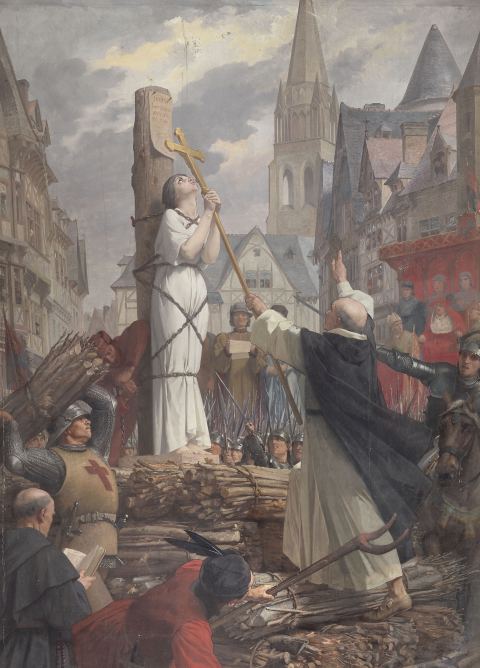
When Joan saw the fire, she told me to get down and to raise our Lord’s Cross very high so that she could see it, and this I did
(Martin Ladvenu, the Dominican holding the cross). Painting by Jules Eugène Lenepveu (1819-1898). Cropped and touched up from a photograph by Hervé Lewandowski / Centre des monuments nationaux, via Wikimedia Commons, under Licence Ouverte 1.0.
12. So What Is The Truth About Joan Of Arc? #
After reading the record, the famous modern claims fall away one by one, and what’s left is almost embarrassingly simple: a pious Catholic girl who called herself, without pretension or propaganda, the Maid
, a virgin consecrated simply and purely to God.
Joan may have possessed lofty and mystical traits too, but in essence she remained a very simple young girl
. Upon hearing that she was to be burnt alive the next morning, her first thought was not of glory or legacy but of purity: Must this body, so far undefiled, now be burnt to ashes in a woeful death?
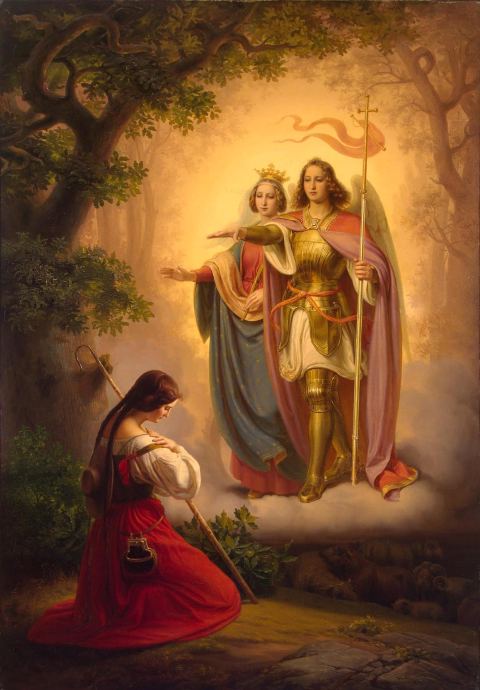
Joan of Arc sees Saints Catherine and Michael in Hermann Anton Stilke’s 1843 painting, Appearance of Saints Catherine and Michael to Joan of Arc, now held at the Hermitage Museum.
Her passage into Heaven was through a refining fire, literally. As Mark Twain, no Catholic himself, put it: She rises stainlessly pure, in mind and heart, in speech and deed and spirit, and will so endure to the end of time.
The best definition of St. Joan of Arc is surely found in the St.
that stands before her name. She is, first and foremost, a Catholic saint, and aren’t we proud to claim her as one of our own.
So let’s let Joan have the last word in refuting the myths:
The truth about Joan of Arc is that:
- She was a staunch Catholic: in a letter to the proto-Protestant Hussites she wrote:
I will eliminate your false and vile superstition and relieve you of either your heresy or your life. But if you would prefer to return to the Catholic faith and the original light, then send me your ambassadors and I will tell them what you need to do.
- She was a proud virgin:
The first time I heard the Voice I vowed to remain a virgin for as long as it pleased God.
- She was humble and simple:
Joan was a kind, humble and gentle girl; she went often and willingly to church and holy places… she kept busy as other girls do, doing housework and sometimes spinning; I saw her; she minded the flocks like her father did.
- She was not a radical feminist:
I would rather be home, spinning wool beside my mother in Domrémy. But I must obey my Lord’s orders.
(She also boasted, incidentally, that shedid not fear any woman of Rouen in spinning and sewing.
Make of that what you will.) - She was not a cross-dresser: asked why she had resumed male clothing, she replied
that she had done it for the protection of her virginity, for she was not secure while wearing female clothing with her guards, who had tried to rape her.
Final Thoughts #
And the paperwork that outlived her says the same thing in its own dry way. While she lived, churches across France were singing a collect composed in her honour: as by the hand of a woman Thou hast delivered Thy people.
At her request, Charles exempted her home village of Domrémy from royal taxation, and French kings kept honouring it for three hundred years: on the tax rolls the entry beside her village read simply Nothing, the Maid,
still confirmed by Louis XV in 1723. The city of Orléans paid a monthly pension to her mother Isabelle for the rest of Isabelle’s life, and has celebrated the 8th of May, the anniversary of its deliverance, ever since. The town’s own account books go further: as early as 1432, while Joan was still officially a condemned heretic, Orléans was buying wax tapers and paying eight friars of the mendicant orders to sing eight masses of the dead for the Maid Joan
at the anniversary. And her family never quite let go of the title either: her brother Pierre’s son went through life as Jean de la Pucelle
, John of the Maid, and the town was still buying wine for his wedding in 1457. Even Napoleon, asked to approve a statue of her in 1803, replied that Joan had proved there is no miracle which the French genius cannot operate when national independence is threatened.
This whistle-stop tour of the record may not convince everyone, and I haven’t even touched the stranger mystical details, like the Ladies’ Tree at Domrémy, beneath which the village children danced on Laetare Sunday under a bower the old folk said had once belonged to the fées, and which her examiners tried very hard to turn into witchcraft. But the truth about Joan of Arc turned out to be simpler, holier and far more compelling than anything her modern claimants have made of her.
A nineteen-year-old who could barely read or write sat in chains and out-argued the greatest theological faculty in Europe for three months. She broke for a single afternoon on a scaffold, then took it all back at the cost of her life. That, I think, is a saint.
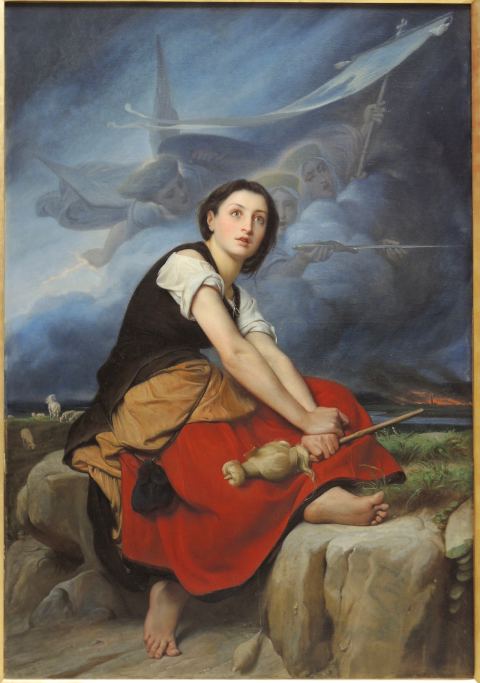
Joan of Arc listening to her voices, painted by Léon-François Bénouville (1821-1859). The painting hangs in the Musée des Beaux-Arts de Rouen, France. Photo by Wuyouyuan, used under CC BY-SA 4.0, no changes made. Source: Wikimedia Commons.
Think I’ve missed something? Feel free to message me on Facebook or by email here.
Want more?
- Read next Why Was St. Joan Of Arc Burned To Death?
- Browse the full Trial of Condemnation of Joan of Arc on this site.
- Join our St. Joan of Arc Facebook group.
- Watch my (somewhat awkward) dictation of Joan of Arc’s life on YouTube.
- Or watch this song I wrote about her below!