 Catholica

Advent is the Catholic season of preparation for Christmas: the four Sundays, and the weeks between them, before we celebrate the birth of Jesus at Bethlehem. The name comes from the Latin adventus, “coming”—and the Church means it in two directions at once, looking back at Christ’s first coming and forward to His return at the end of the world.
I did grow up with Advent—but not with the liturgy. I was raised a charismatic evangelical, so the season meant the run-up to Christmas; the Church’s own four weeks of preparation were new to me. My Advent has become more liturgical since I became Catholic. So I still came to much of this as an adult with the same questions most people have: when does it start, what do the candles mean, and what are you actually supposed to do? Here are the answers.
When does Advent start? #
Advent begins on the Sunday nearest to 30 November, the feast of St Andrew. That means the first Sunday can fall anywhere between 27 November and 3 December, and the season lasts between three and four weeks. It ends on Christmas Eve, 24 December, when the Christmas season takes over.
It is also the start of the Church’s year. The liturgical calendar does not begin on 1 January—it begins on the first Sunday of Advent.
In 2026, Advent runs from Sunday 29 November to Thursday 24 December, with the four Sundays on 29 November, 6 December, 13 December and 20 December. Advent 2026 also opens Year B of the Sunday readings, the year in which we hear mostly from Mark’s Gospel.
For the next few years, the first Sunday of Advent falls on:
| Year | First Sunday of Advent |
|---|---|
| 2026 | 29 November |
| 2027 | 28 November |
| 2028 | 3 December |
| 2029 | 2 December |
| 2030 | 1 December |
What does Advent mean? #
Adventus is the Latin word the early Church used for “coming” or “arrival”, translating the Greek parousia—the word the New Testament uses for Christ’s appearing. So Advent is a season of waiting in two directions at once. We prepare to celebrate His first coming at Bethlehem, and we renew our longing for His second coming in glory. The Catechism of the Catholic Church puts it beautifully:[1]
When the Church celebrates the liturgy of Advent each year, she makes present this ancient expectancy of the Messiah, for by sharing in the long preparation for the Saviour’s first coming, the faithful renew their ardent desire for his second coming.
You can feel that double direction in the season’s own rhythm. The first weeks lean towards the Second Coming—the Gospel readings speak of staying awake and being ready for the day of the Lord. Then, from around 17 December, the Church’s gaze turns to Bethlehem, to Mary, and to the Nativity.
The mood of Advent is penitential but expectant. Priests wear violet, and the Gloria is left out of Sunday Mass—we keep the angels’ song for the night they actually sang it. But the Alleluia stays, which tells you something important: Advent is not a second Lent. There is no obligatory Advent fast in the Latin Church today. Older generations did keep a “St Martin’s Lent” of forty days from mid-November, and the Eastern churches still keep a Nativity Fast, but for us that is history rather than rule.
One more distinction worth making: Advent is not Christmas. The shops start Christmas in October; the Church asks us to wait a little first, and to learn again how to want something. Nobody will tell you off for putting your tree up early—there is no rule about that, only custom. But the waiting itself is the point. Something is coming.
The Advent wreath and candles #
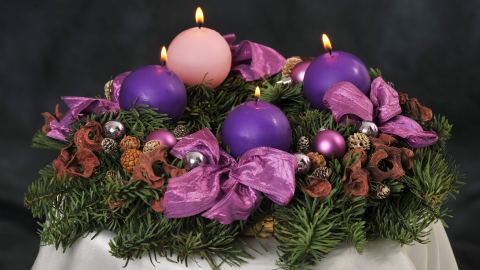
The most visible Catholic Advent custom is the wreath: a ring of evergreen holding four candles—three violet and one rose—one of which is lit on each Sunday as Christmas draws nearer.
Where the Advent wreath comes from #
Honestly, not from Catholicism. The Advent wreath began with Johann Hinrich Wichern, a Protestant pastor in Hamburg, who in 1839 built a wooden ring of candles so the children at his mission school could count the days until Christmas. Catholics adopted the custom in the twentieth century and trimmed it to four candles, one for each Sunday.
I say this honestly because it matters: the wreath is a custom, not a doctrine. The Church blesses it warmly but requires it of nobody. A family that lights one is keeping Advent beautifully; a family that does not has broken no rule.
What the Advent candles mean #
The violet candles match the violet vestments of the season—preparation and penance. The rose one belongs to the third Sunday, Gaudete Sunday, and stands for joy (more on that below).
You will often hear the four candles named hope, peace, joy and love, or the Prophets’, Bethlehem, Shepherds’ and Angels’ candles. That is a common and lovely way to name them, not a liturgical law—if your family uses different names, nothing is broken.
How to light the Advent candles at home #
This is the question converts actually ask, so here it is plainly:
- Light the candles cumulatively. Week one, light the first candle. Week two, light the first and the second. Week three adds the rose candle, and in week four all four burn together.
- Light them at a set moment. Most families do it at the evening meal or at prayer time, then blow them out afterwards. They are not meant to burn all day—for wax’s sake and safety’s sake alike.
- Which violet candle is “first”? There is no rule. Pick one and work your way round the ring.
- The white candle in the middle. Some wreaths add a fifth white “Christ candle” in the centre, lit on Christmas Day. It is an optional custom borrowed from Protestant practice—harmless, but not required.
There is an official blessing of the wreath in the Church’s Book of Blessings—the Directory on Popular Piety explains the custom for use at home—meant to be said the first time it is lit. A short version is in the prayers section below.[2]
And what about the Advent calendar? #
The calendar has the same German roots: nineteenth-century Lutheran families marked the December days with chalk lines or little pictures, and the first printed Advent calendars appeared around 1902–1908, popularised by a Munich printer named Gerhard Lang. Today’s chocolate and toy versions descend from that idea. Counting down the days is a lovely instinct, whatever happens to be behind the doors.
The four Sundays of Advent #
The first Sunday (29 November in 2026) sets the season’s forward look: the Gospel urges us to stay awake and watch for the Lord’s coming. It is also the Church’s New Year’s Day—this Advent opens Year B, the year of Mark’s Gospel.
The second Sunday (6 December) belongs to John the Baptist, the voice crying in the desert: “Prepare the way of the Lord.”
The third Sunday (13 December) is Gaudete Sunday, from the entrance chant Gaudete in Domino semper—“Rejoice in the Lord always” (Philippians 4:4). The penitential season pauses for a breath of joy, because the Lord is near. This is why there is a pink candle: rose vestments may be worn, and the rose candle is lit.
The fourth Sunday (20 December) gathers round Mary and the approach of Bethlehem. The waiting is nearly over.
What do you do during Advent? #
At home #
- Light the wreath at the evening meal, using the simple rhythm above, and say a short prayer together.
- Keep a daily prayer habit, even a ten-minute one. The day’s Mass readings are a good anchor—the USCCB publishes them every day on its Bible site—and the Joyful mysteries of the Rosary suit the season exactly, since they walk through the Annunciation, the Visitation and the Nativity.[3]
- Go to confession before Christmas. Most parishes run an Advent penitential service, and there is no better way to “prepare the way” than the one John the Baptist actually prescribed.
- Give something. Generosity is the season’s own shape. Some people also keep an optional fast—the old “St Martin’s Lent” idea has its modern fans—but it is a devotion, not a duty.
- Set up a nativity scene. St Francis of Assisi made the first living crib at Greccio in 1223. Many families leave the manger empty until Christmas morning, so the Baby arrives when Christmas does.
- The Christmas tree has no Church rule attached—put it up when it helps you keep the season. If you would like to mark it, the Church even has a blessing of the Christmas tree in the same Directory on Popular Piety.
At church and around the world #
At Mass you will notice the violet vestments, the missing Gloria, and Advent’s own hymns—above all O Come, O Come, Emmanuel, whose verses are built from the ancient “O Antiphons” sung at evening prayer from 17 to 23 December: O Wisdom, O Lord, O Root of Jesse, O Key of David, O Morning Star, O King of the Nations and O Emmanuel.
Different countries keep the season in their own ways: dawn Rorate Masses celebrated by candlelight; the Philippines’ Simbang Gabi, nine early-morning Masses in a row; Mexico’s Las Posadas, the candlelit re-enactment of the search for lodging from 16 to 24 December; and the candle-crowned processions of St Lucy’s day.
The December feasts #
Advent is dotted with feast days that are worth knowing:
- St Nicholas, 6 December. The real bishop behind the gift-giver; in much of Europe children still find treats in their shoes.
- The Immaculate Conception, Tuesday 8 December. A solemnity, and a holy day of obligation in several countries including the United States. Worth saying plainly: it celebrates Mary’s conception, free from original sin—not the virginal conception of Jesus. The confusion is very common. (More on this and the other Marian dogmas on our Mary page.)
- Our Lady of Guadalupe, 12 December. The feast of Our Lady’s appearance to St Juan Diego in 1531; a day of huge celebration across the Americas.
- St Lucy, 13 December. The young Roman martyr whose name means “light”—a fitting saint for the darkest week of the year.
Advent Bible verses #
The texts below are the ones the Church herself leans on during Advent, which is why they keep turning up in the season’s Mass readings:
- God’s promise of a coming king: Isaiah 7:14 (a virgin shall conceive), Isaiah 9:6 (unto us a child is born), Micah 5:2 (from Bethlehem shall come the ruler).
- The voice in the desert: Isaiah 40:3 and Mark 1:3—“Prepare the way of the Lord.”
- Mary’s yes: Luke 1:26–38 (the Annunciation) and Luke 1:39–56 (the Visitation and her Magnificat).
- Watching for the second coming: Matthew 24:37–44 and 1 Thessalonians 5:2–6.
- The Gaudete command: Philippians 4:4–5—“Rejoice in the Lord always; again I will say, rejoice. The Lord is at hand.”
The Church has been singing this waiting for a very long time. St Ephraim the Syrian’s fourth-century Hymns on the Nativity are still among the loveliest Advent reading there is—and for a sermon, St Augustine on the feast of the Nativity is just as good.
Advent prayers #
Here are three real prayers for the season, beginning—as all prayer in our house does—with the Sign of the Cross.[4]
The Church’s own opening prayer for the first Sunday of Advent, from the Roman Missal, is a good daily prayer for the whole season:
Grant your faithful, we pray, almighty God,
the resolve to run forth to meet your Christ
with righteous deeds at his coming,
so that, gathered at his right hand,
they may be worthy to possess the heavenly Kingdom.
Through our Lord Jesus Christ, your Son,
who lives and reigns with you in the unity of the Holy Spirit,
God, for ever and ever.
Amen.
And this is the traditional blessing said the first time the Advent wreath is lit, from the Church’s Book of Blessings:
O God, by whose word all things are sanctified,
pour forth Thy blessing upon this wreath,
and grant that we who use it
may prepare our hearts for the coming of Christ
and may receive from Thee abundant graces.
Through Christ our Lord.
Amen.
Finally, the hymn that is itself the sound of Advent—the first verse of O Come, O Come, Emmanuel:
O come, O come, Emmanuel,
and ransom captive Israel,
that mourns in lonely exile here
until the Son of God appear.
Rejoice! Rejoice! Emmanuel
shall come to thee, O Israel.
Advent is the Church’s way of saying: someone is coming, so slow down enough to notice. A wreath, a daily prayer and Sunday Mass is a real Advent—and a very good place to start.
Suggested next reading: When was Jesus born?
Sources #
1. Catechism of the Catholic Church, §§522–524—the Church’s own account of what Advent is for. ↑
2. Directory on Popular Piety—the Vatican document covering Advent customs, the wreath blessing and the Christmas tree. ↑
3. Daily Mass readings—the day’s Advent readings, published every day. ↑
4. USCCB Advent resources—prayers and practices from the US bishops. ↑