 Catholica

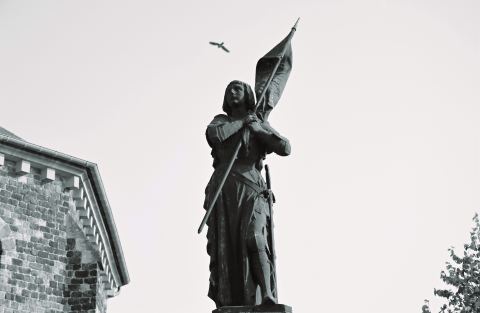
On 30th May 1431 an illiterate peasant girl from the small, simple town of Domrémy in Northeastern France was put to death by burning in the Old Market of Rouen. This petite young woman was St Joan of Arc (Jeanne d’Arc in French). But why was St Joan of Arc burned to death?
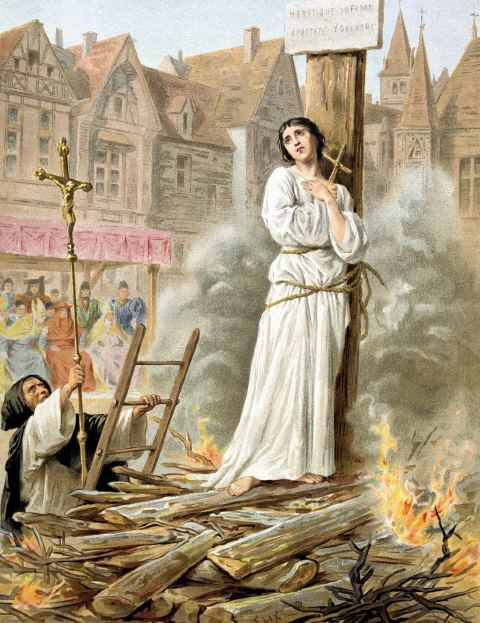
It is one of those questions with two answers. There is the answer written in her death sentence, and then there is the real one, and the gap between them is the most interesting part of the whole story. I spent a long time buried in the record of her Trial of Condemnation and in the Trial of Rehabilitation that re-examined it a generation later, and here is what I found.
1. The Simple Answer #
Any biography of Joan of Arc will tell you that her appearance on the scene of the Hundred Years’ War in 1429 caused an uproar in Western Europe. She was loved by the French who were loyal to the Dauphin Charles VII, admired by other Europeans such as the Italian poet Christine de Pisan, and hated by the Burgundians and the English.
It could be said that, in some sense, she was the marmite of the 15th Century. Depending on who you were (and whose side you were on), you either loved or loathed her.
The simple, legal answer to our question is this: Joan was burned as a relapsed heretic. After months of interrogation she was convicted of wearing men’s clothing against the law of God, abjured her errors on a public scaffold, and then, days later, put the men’s clothing back on. A relapsed heretic could be handed to the secular power to be burned, and she was.
And yet even that answer is stranger than it looks, because the men’s clothing was not really the reason she died. To see the real one, you have to look at a coronation.
2. A Crown Received From Satan #
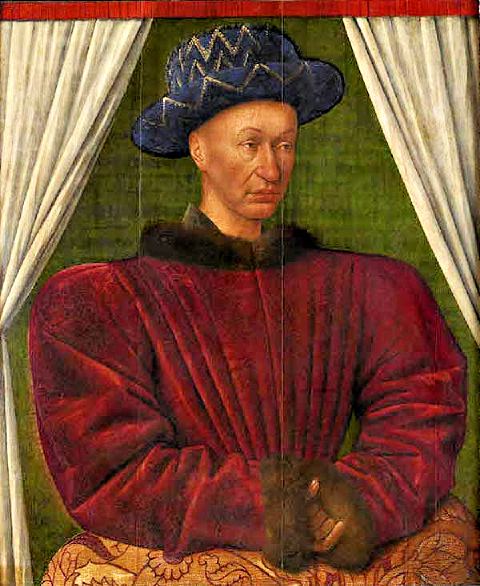
A portrait of King Charles VII painted around 15 years after Joan’s death. | Why Was St Joan Of Arc Burned To Death?
In the summer of 1429, Joan had done the impossible. She had lifted the siege of Orléans, routed the English at Patay and marched Charles VII deep into enemy territory to be crowned and anointed at Reims on 17th July. And because her claim to be sent by God had been tested by French theologians at Poitiers and found worthy of belief, all of it was understood on both sides of the war as proof that God was on the side of the French.
That was the problem. If Joan was sent by God, then Charles was crowned by God, and the English claim to the French throne was simply wrong. But if Joan was a witch, inspired by demons and burning for heresy, then Charles VII had been crowned through sorcery: a king whose crown came from Satan.
Joan had stated the threat in writing herself, in a letter dictated weeks before Orléans and delivered into the English siege lines, addressed to the king of England, the regent Bedford and his captains. It ordered them to surrender to the Maid, sent here by God the King of Heaven,
the keys of all the good towns they had taken and violated in France,
and warned that she had come to drive you out of all France.
And it made the claim that sealed her fate: you shall not hold the kingdom of France from God… King Charles, the true heir, shall hold it, for God wills it so, and it is revealed to him by the Maid.
To the English commanders who read it, that letter was a declaration of war on their king’s title, signed by heaven.
Even the enemy’s own chronicles record what she meant to the French cause. A London city chronicle, written for English readers, calls her a fals wyche
— and in the same sentence admits that the dolphyn and alle oure adversaries trusted holy to have conquered ayen alle Fraunce,
held her among them as for a prophetesse and a worthy goddesse,
and never had the worst of it in place that sche hadde ben inne.
Wherever Joan stood, the English lost. The witch had to be invented, because the prophetess was winning.
The English said as much in writing. The German abbot Johannes Trithemius, summarising the English case a few decades later, states that they burned her as a sorceress and heretic
to show that the king of the Franks, whom all call by the special title of most Christian, had strayed from the Catholic faith, and therefore to acclaim him unworthy of the realm, forasmuch as the said king had received the Maid, whom they judged a sorceress, and had given credence to her words.
In short: ruin Joan, and you ruin Charles.
Nor was it only a matter of propaganda. Her enemies feared her in the most practical way possible. The Burgundian chronicler Enguerrand de Monstrelet, who was present at her capture at Compiègne on 23rd May 1430, records that the Burgundians and English rejoiced more than if they had taken five hundred fighting men: for they dreaded and feared no captain or other chief of war so much as they had ever done, until this present day, the said Maid.
And the fear outlived her capture. Henry VI’s government had to issue edicts ordering sheriffs to arrest soldiers who had deserted rather than sail to France, men whom the terrors of the Maid had driven out of their wits.
One Dominican friar testified that the English had been about to besiege the town of Louviers, but put it off until Joan was dealt with, deeming that during her life they would never have glory or prosperity in the business of war.
The moment she was ash, they marched on Louviers.
So the English needed her dead. But they could not simply kill her.
3. Why They Couldn’t Just Kill Her #
A prisoner of war who turns up strangled in her cell becomes a martyr by teatime. What the English needed was worse than a corpse: they needed a Church verdict declaring that the girl who had crowned Charles was a heretic and a fraud, so that the crown itself would rot with her.
That meant it had to be a Church trial, run by Churchmen, ending in a Church sentence. And it meant the verdict had to be bought.
The receipts survive. Jean de Luxembourg, the Burgundian lord whose men had dragged Joan from her horse, sold her to the English crown for ten thousand livres tournois: a king’s ransom for a teenage girl, recorded in the English treasury accounts as payment to have Joan who calls herself the Maid, prisoner of war.
The man they hired to judge her was Pierre Cauchon, Bishop of Beauvais, a counsellor to the King of England whose compliance was sweetened by the promise of the vacant archbishopric of Rouen. His own expense claim survives too: 765 livres for 153 days of work for the business of Joan who is called the Maid,
including the journeys to Burgundy and to Luxembourg to negotiate her purchase, all before her trial had even opened. The doctors of the University of Paris who pronounced her a heretic were likewise paid a daily rate to attend. Her trial had a price list, and everyone on it was English or paid by England.
4. A Verdict In Search Of A Trial #
Even so, buying the verdict was the easy part. Producing it was harder, because the defendant was a nineteen-year-old who out-argued the finest theological faculty in Europe for three months.
The fix was in everywhere you look in the record. A priest named Nicolas Loyseleur was planted in her cell posing as a captured French loyalist from her home province; he won her trust, heard her confession, and reported everything back to Cauchon, while notaries listened through a hole in the wall so that her private words could be turned into trap questions in court.
Church law said a prisoner of the faith belonged in a Church prison, and when the judges themselves were asked at the outset, they agreed it was more decent that she be kept in one. Cauchon refused, in his own words, for fear of displeasing the English,
and left her chained in an English military castle guarded by English soldiers, a detail that matters enormously later. Pierre Cusquel, whose master ran Rouen’s building works, swore at the rehabilitation that an iron cage had been weighed out in his own house — made, he was told, to shut Joan in.
She appealed to the Pope, and was refused. When a friendly friar suggested she submit herself to the general Council of Basel instead, where her own side would be represented, she immediately agreed: Oh! since in that place there are some of our party, I am well willing to yield and submit myself to the council of Basel.
Cauchon shouted him down, Hold your peace, in the devil’s name!
, and ordered the notary not to write her submission down. When the same friar was caught quietly prompting her answers in a later session, the Earl of Warwick threatened to have him thrown into the Seine. When another assessor quietly asked the elderly Bishop of Avranches for St Thomas Aquinas’s ruling on appeals, and the answer came back that doubtful matters of faith should go to the Pope or a general council, the rehabilitation record says that answer was left out through malice.
The charges that made it to her sentence were, in typical deceitful fashion, the facts of her life distorted: her visions of saints became visions of demons; her leap from the tower of Beaurevoir — made, she said, because she had heard that everyone in Compiègne over the age of seven was to be put to fire and blood, and in the hope of saving my body and of going to succor many good people who were in need
— became a suicide attempt born of despair; her refusal to submit to her English judges became a refusal to submit to the Church.
But the charge that finally killed her was none of these.
5. Death By Trousers #
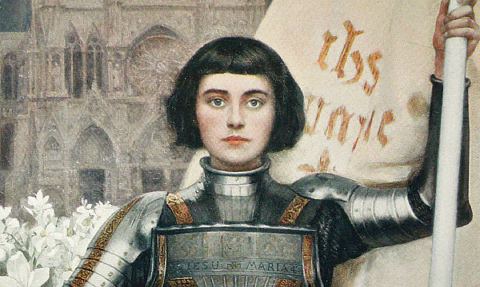
Joan also wore her hair shorter during her military career and while in prison. The eminent and contemporary theologian Jean Gerson defended her hairstyle for practical reasons. | Why Was St Joan Of Arc Burned To Death?
It was, believe it or not, her clothes.
Not her visions, not her letters, not the war itself. The accusation that could be proved by simply opening a cell door was that she dressed as a man: a tunic, hood and doublet, the ordinary working dress of a soldier.
As theology it was a thin charge, and Joan’s side knew it. St Thomas Aquinas had written, a century and a half earlier, that necessity made even cross-dressing permissible. Joan’s necessity was not subtle: she was a young woman held night and day among male guards in an English military prison, and she explained plainly that men’s dress was more permissible or convenient
while she was among men. Later witnesses were blunter still: it was, they swore, the only reliable protection of her virginity in that cell.
As prosecution strategy, though, it was clever. Whether her voices were from God or the devil was unprovable either way. Whether she was wearing men’s clothes was a fact the judges could check for themselves, and, better still, could arrange. It became the tripwire they waited for.
First, though, they needed her to take it off.
6. The Day She Broke #
On Thursday 24th May 1431 Joan was taken to the cemetery of Saint-Ouen and put on a public scaffold. This was no quiet threat in her cell; it was theatre, staged in front of a crowd. The preacher, Master Guillaume Erard, used his sermon to call Charles VII, to her face, a heretic and a schismatic,
the real target of the trial said aloud at last. Joan, standing on his scaffold, answered that her king was the noblest Christian of all Christians,
until the preacher ordered someone to make her hold her peace.
Then they began to read out her death sentence. Joan interrupted — not to surrender, but to appeal over their heads, saying in a loud voice that she referred herself to the universal Church as to whether she ought to abjure. Erard gave her the binary: Thou shalt abjure them presently, or thou shalt be burned.
And somewhere in the middle of the sentence being read, she broke. She agreed to submit, and signed the abjuration confessing she had lied about her revelations — signing not even with a name she could not write, but with a cross, made with the pen of the court usher Jean Massieu. An illiterate girl signing a document she had not understood was, by the Church’s own later reckoning, no informed consent at all. Her death sentence was commuted to life imprisonment.
The English were furious. That is not a figure of speech: within days, eighty to a hundred of their soldiers mobbed the churchmen in the castle courtyard calling them traitors for letting her live. Loyseleur, the spy, told her she had done a good day’s work
and saved her soul. Joan made one request, reasonable and utterly within her rights: now that she had submitted to the Church, take her out of English hands and into a Church prison.
Cauchon’s answer: Take her back where you found her.
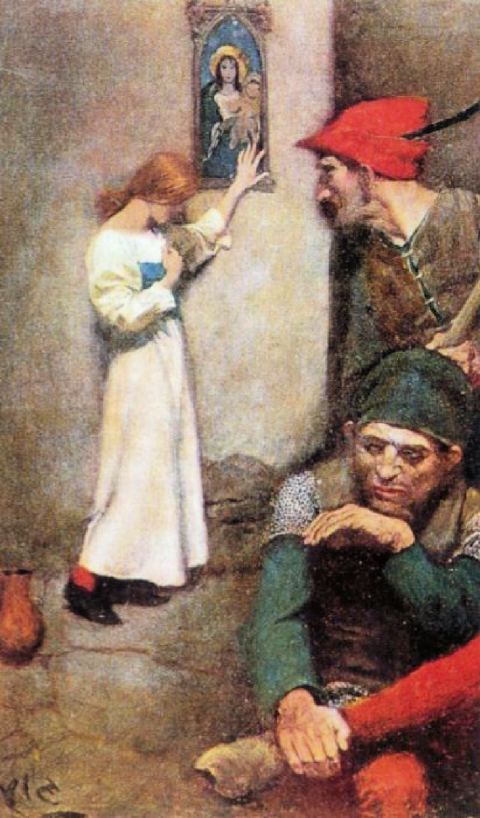
That answer — not the sentence read on the scaffold — is what killed her. She went back to the same cell, the same guards, the same chains. And the men’s clothes she had just abjured? They were not even taken away. They went into a sack, kept in the very room where she was held.
7. How The Relapse Was Made #
“You say that you are my judge. I do not know if you are! But I tell you that you must take good care not to judge me wrongly, because you will put yourself in great danger. I warn you, so that if God punishes you for it, I would have done my duty by telling you!” — St Joan of Arc | Why Was St Joan Of Arc Burned To Death?
What happened on Trinity Sunday morning is the contested heart of this story, and the two versions may both be true.
Joan’s own recorded answer, given to the judges on the Monday, was careful. She said she had resumed men’s clothing of her own will, that it was more convenient among men, and that the promises made to her at her abjuration had not been kept: she had not been taken to Mass, she had not received the Eucharist, and she was still in irons.
But Jean Massieu, the court usher who was in and out of her cell daily, swore at her rehabilitation trial what the guards had actually done. By night she lay chained by the legs with two pairs of irons, locked to a beam at the foot of her bed, five Englishmen guarding her. On the Sunday morning she asked to be unchained to rise, and the guards took her woman’s dress, emptied the sack containing the men’s clothes over her and told her to get up. She refused all morning, Sirs, you know that it is forbidden me; without fail, I will not take it,
until, at midday, bodily necessity forced her out of the bed and into the clothes they had given her. When she came back, they would not give her the woman’s dress however much she begged.
Friar Martin Ladvenu, her confessor, swore a darker addition: that after her abjuration she had been violently tormented in the prison, molested, beaten and despoiled,
and that an English milord had forced her.
Friar Isambert de la Pierre saw her days later weeping, her face full of tears, disfigured and outraged.
However it happened, exactly as the prosecutors needed, the prisoner stood before her judges dressed as a man again.
And then she did the thing that truly sealed it. Asked whether she had heard her voices since the scaffold, she said she had, and that they had told her of the great pity of that great betrayal
she had consented to in abjuring: she had condemned herself to save her life.
Everything she had said on that scaffold, she said, she had said out of fear of the fire,
and if she denied that God had sent her she would be condemning herself, because it was true that God had sent her. In the margin of the clerk’s minute, against this answer, three words were written: A deadly answer.
She added that she would rather do her penance all at once, by dying, than endure the prison any longer.
And here is the detail that breaks my heart. In the same breath she offered the judges their compromise: if the judges wished, she would resume women’s clothing; for the rest she would do nothing else.
The dress was negotiable. Her voices were not. She was offering to give them everything except the one thing the trial existed to take.
Cauchon walked out of her prison that day, saw the Earl of Warwick waiting with a crowd of Englishmen, and, laughing, called out to them: Farewell, farewell, it is done with her, make good cheer.
8. The Sentence Nobody Pronounced #
On Tuesday 29th May the assembled doctors voted, one after another, that she had relapsed. On the morning of Wednesday 30th May 1431 she was taken to the Old Market of Rouen, where Master Nicolas Midi preached to a crowd over a girl on a scaffold who had spent the dawn weeping, confessing and receiving the Eucharist. In front of the scaffold they hung a board itemising the charges against Jehanne who had herself called the Maid:
liar, pernicious, deceiver of the people, diviner, superstitious, blasphemer of God, presumptuous, unbelieving, boaster, idolater, cruel, dissolute, invoker of devils, apostate, schismatic and heretic — and on her head they set a tall paper mitre painted with the words heretique, relapse, apostate, ydolatre.
A Parisian royal notary, a man working for the English-backed government, copied the entire inscription into his official register that week — and then added a line of his own in Latin: it is said that in the end she repented tearfully and showed signs of penitence. Deus sue anime sit propicius et misericors:
may God be merciful to her soul.
The sentence declared that she had returned to her errors as a dog is wont to return to its vomit,
declared her a relapsed heretic, and handed her to the secular power with the traditional pious request that it moderate its judgment concerning you, short of death and mutilation of limbs.
Everyone understood the fiction: the Church would not burn her; it would simply leave her where burning was certain.
Except that the fiction was never even completed. Two eyewitnesses, Friar Isambert de la Pierre and Friar Ladvenu, swore later that the secular judges sitting on their own scaffold never pronounced any sentence at all. There was no condemnation to death. She was simply marched down and handed to the executioner with the words: Do your duty.
The authorities knew it was irregular: when the next suspected heretic was handed over, the Church formally warned the secular officers not to treat him as the Maid had been, who, without final sentence and definitive judgement, was consumed by the fire.
She prayed aloud for about half an hour, forgiving her enemies and asking the crowd, French and English alike, to pray for her, until, the record says, even the English were in tears. She asked for a cross; an English soldier fashioned her a little one from the end of a staff, which she kissed. She died with the name of Jesus on her lips while Friar Ladvenu held the crucifix high so she could see it through the flames.
The executioner came to the friars afterwards half-mad with horror, swearing that despite the oil, sulphur and coal he had applied, he could not burn her heart or entrails to ash. The English were taking no chances even with what was left of her. When the flames had done their work they ordered the executioner to part the fire so that the crowd could see her charred body — a witness at her rehabilitation says it was done lest it be said that she had escaped
— and then had the ashes raked together and thrown into the Seine, lest, in Pope Pius II’s words, they should some time be an honour.
But the fear had already spread inside the English machine. John Tressart, secretary to the king of England, came back from the marketplace weeping and lamenting what he had seen: Nos sumus omnes perditi, quia una sancta persona fuit combusta — we are all lost, for a holy person has been burned.
And the people of Rouen agreed with him: the same rehabilitation record notes that nearly the whole town was murmuring that a great injury and injustice had been done to Joan.
Meanwhile the whitewash went out by post. The government of the boy-king Henry VI sent circular letters to the Emperor, kings, dukes and other princes of all Christendom,
and to the bishops and nobles of France, announcing the just punishment of an erroneous diviner:
a woman of wondrous presumption who had dressed as a man, boasted of visions of St Michael and St Catherine, and seduced the people for nearly a year. The letter insists that although Joan had inflicted great losses on the English, it was not our intent to avenge the injury,
nor to hand her straight over for punishment — the king had merely answered the bishop’s request and delivered her to the judgement of Holy Mother Church, as befits a Christian king.
The crown that had paid ten thousand livres for her wanted every court in Europe to understand that England had not killed her. The Church had. That was the whole point of the purchase.
A Dominican named Brother Peter Bosquier dared to say publicly that her judges had done ill.
They sentenced him to prison on bread and water until the following Easter. Telling the truth about her trial was already dangerous before her ashes were cold.
9. So Why Was St Joan Of Arc Burned To Death? #
Here, then, is the honest answer.
Legally, Joan of Arc was burned because she was a relapsed heretic: she had abjured her errors, then resumed men’s clothing and reaffirmed her voices. That is what the sentence says, and it is formally true.
Really, she was burned because the English needed two things at once. They needed the most feared commander in France removed, the girl they dreaded more than five hundred fighting men, the reason their own soldiers were deserting. And they needed her destroyed not as a prisoner but as a fraud, so that the coronation she had made possible at Reims could be written off as the work of a witch, and Charles VII’s crown as a gift from Satan.
That second answer is not a modern revision; it was the common report at the time. The clerk who kept the municipal register at La Rochelle recorded flatly that she was burned at Rouen par faux témoignages et accusements
— by false testimony and false accusations. A chronicle kept at Tournai reports what ordinary people were saying: that she had been destroyed through the envy of captains and of councillors more loyal to her enemies than to their own king, the judges having found no other cause or guilt except that she had worn men’s clothing.
The same verdict kept being repeated for a century afterwards — Varanius’s Latin epic has the English able to allege no crime in the girl except her arms and her male clothing,
and Fronton du Duc’s tragedy protests that her judges found no greater pretext than that she had abused her sex.
A dress was the only thing they could prove, because a dress was all they ever had.
The men’s clothing was the tripwire they set for her, and the relapse was, in the words of her own rehabilitation proceedings, feigned and contrived:
her woman’s dress was taken from her, her guards had tried to rape her, and the promises that had won her signature were never kept. As the Church’s own promoter later summarised it, she was coerced and not having woman’s garments… compelled to take man’s dress for the protection of her chastity.
Whatever the judges chose to call it, the practical effect was this: a chained girl put back on the clothes that protected her from the men guarding her, and was burned for it.
10. The Verdict They Couldn’t Defend #
The men who ran that trial knew what they had done. When the judges afterwards drew up a document claiming Joan had confessed on her last morning that her voices had deceived her, the sworn notaries who had recorded everything else in her trial refused to sign it.
The truth caught up in the end. Once Normandy was back in French hands, Charles VII’s own commission admitted that the English had caused Joan to die iniquitously and against reason, most cruelly.
And on 7th November 1455, in the church of Paris, an elderly widow named Isabelle d’Arc threw herself at the judges’ feet with great groans and sighs,
holding the Pope’s rescript in her hands, and demanded her daughter’s name back:
“I had a daughter, born in legitimate marriage, whom I fortified worthily with the sacraments of baptism and confirmation and raised in the fear of God and respect for the tradition of the Church… Nevertheless, certain enemies betrayed her in a trial concerning the Faith, and, without any aid given to her innocence, in a perfidious, violent, and iniquitous trial, without shadow of right, they condemned her in a damnable and criminal fashion and made her die most cruelly by fire.” — Joan’s mother, Isabelle Romée, opening the trial that vindicated her daughter | Why Was St Joan Of Arc Burned To Death?
On 7th July 1456 the Church gave its answer. The falsified articles sent to Paris were declared corruptly, guilefully, calumniously, fraudulently and maliciously
extracted, and the judges decreed them torn out of the record. The whole process — every session, both sentences, the abjuration, the execution and everything that followed from it — was pronounced null and void, invalid and irritated and inane,
containing guile, calumny, iniquity, repugnance and manifest error of law and fact.
Nearly five centuries after that, on 16th May 1920, the same Church that had failed her at Rouen declared her a saint.
So the real answer to why was St Joan of Arc burned to death?
is not in the end about a dress code. It is about a frightened occupying power, a purchased bishop, and a nineteen-year-old they could neither beat nor break, only delegitimise and depose.
Saint Joan of Arc, pray for us!
Want More? #
- Read next The Real Truth About Joan Of Arc.
- Browse the full Trial of Condemnation of Joan of Arc and the Trial of Rehabilitation on this site.
- Join our St. Joan of Arc Facebook group.
- Watch my (somewhat awkward) dictation of Joan of Arc’s life on YouTube.
- Or watch this song I wrote about her below!